
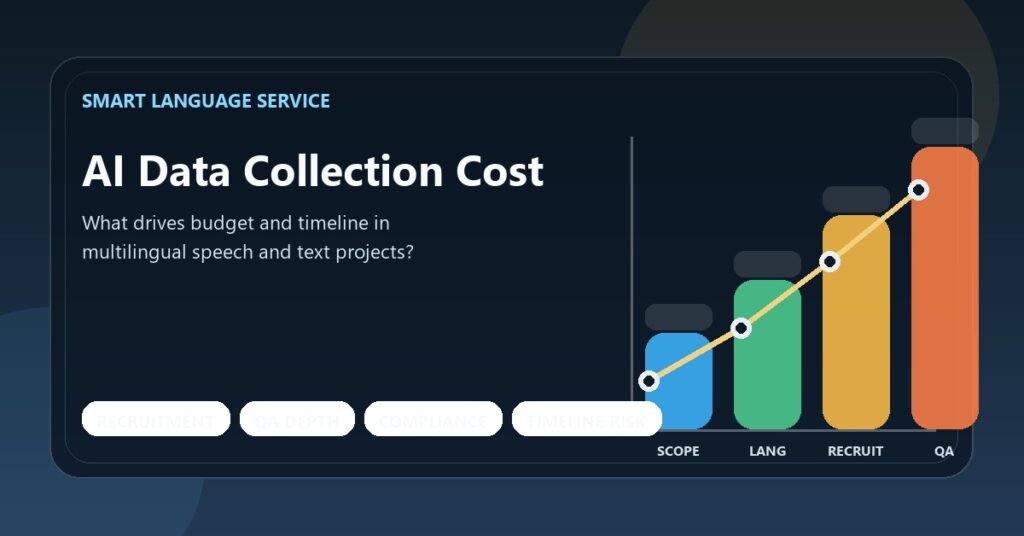
Why AI data collection cost is shaped by constraints, not just volume
Many buyers start an AI data collection discussion with one simple question: what is the price per hour, per utterance, or per sample? That question matters, but it rarely explains the final budget. AI data collection cost is usually driven less by raw unit count than by the operational constraints wrapped around the project. The same target volume can be inexpensive in one market and expensive in another because the recruiting pool, device requirements, consent model, quality threshold, and turnaround logic are completely different.
This is especially true for multilingual speech and text data programs. A dataset with broad language coverage may look straightforward in a spreadsheet, yet each market can introduce its own participant availability, privacy expectations, dialect mix, environmental limitations, and validation burden. A buyer who prices only the collection event often discovers later that the real cost sits in preparation, exception handling, QA, and rework.
The practical way to estimate budget is to break the program into cost drivers that can actually move. If you understand which assumptions change recruitment difficulty, recording speed, QA depth, and release readiness, you can compare vendors more intelligently and avoid approving a quote that is low only because important work has been left out.
Scope assumptions can change the quote before recruitment starts
The earliest budget variable is scope clarity. Teams often say they need speech data, image data, or multilingual text, but that label is too broad to price accurately. A useful scope defines the task, the target model use case, the source format, the target geography, the volume, and the failure tolerance. If any of those are vague, the quote usually contains hidden contingencies.
For example, a speech dataset for wake-word tuning, a speech dataset for customer support ASR, and a speech dataset for call-center QA may all use audio, but they require different speaker pools, prompt structures, metadata, and review rules. Likewise, text collection for search relevance, chatbot evaluation, and document classification should not share one generic budget model. The project is not expensive because it is "AI data." It becomes expensive when operational assumptions are discovered late.
This is why serious vendors ask questions that feel detailed early in the process. They are trying to measure how much ambiguity remains around task boundaries, edge cases, acceptance thresholds, and exception handling. Buyers should expect that discipline. When a supplier can quote quickly without clarifying the workflow, it may mean the project is being under-scoped rather than efficiently priced.
Language mix and market coverage affect both price and timeline
Language count alone does not describe multilingual cost. What matters is the combination of language, market, dialect spread, literacy expectation, and participant density. English in one metropolitan market is not operationally equivalent to Arabic across several countries, or to lower-resource regional variants that require more specialized sourcing.
Two projects with identical sample counts can diverge sharply in cost when one requires dense coverage of accents, age bands, or rural participants. If the model will be used in customer-facing scenarios, the buyer may also need language variation that reflects real market behavior rather than neat textbook phrasing. That increases sourcing effort and usually expands validation time because the dataset contains more linguistic diversity to inspect.
The same logic applies to text collection. A multilingual dataset may require different moderation rules, script-specific normalization, and separate reviewer calibration for each language. Our posts on collecting domain-specific data for AI and how to build a multilingual dataset for customer support AI explain why market realism matters so much. In cost terms, realism is not a nice extra. It is a budget driver.
Participant recruitment is where many budgets expand
Recruitment often looks simple on paper because buyers assume participants are plentiful. In practice, eligibility rules determine whether recruitment is routine or difficult. Cost rises when the project needs narrow demographics, specific professions, rare dialects, uncommon devices, controlled environments, or repeat contributors who can follow detailed instructions.
Speech data programs make this visible very quickly. If the specification requires native speakers from multiple cities, balanced gender and age ranges, low-noise recording conditions, and several rounds of prompt completion, the project is no longer a generic participant pool exercise. It becomes a managed field operation. Incentive design, reminder cadence, dropout handling, and replacement sourcing all start to matter.
Consent and privacy requirements can raise recruitment effort further. Projects that collect voice, biometric-adjacent signals, or sensitive contextual information may need stronger consent scripts, identity checks, storage controls, and audit trails. That is operationally necessary, but it adds cost and scheduling dependencies. Buyers should account for those controls at the beginning rather than treating them as post-approval admin. Our guide to voice data collection consent is relevant here because consent design directly affects field throughput.
Capture specifications create real production cost
The moment a project defines collection quality in detail, the budget model changes. Sample rate, recording device type, microphone distance, ambient noise tolerance, image resolution, document formatting, metadata completeness, and prompt complexity all influence how fast contributors can produce acceptable data. Higher quality is often the right decision, but it is never free.
For speech datasets, strict capture rules usually increase rejection and re-record rates. A short script may seem inexpensive until the team realizes it must be captured in a quiet room, on a specific mobile device, with precise speaking style and metadata fields completed correctly. The work then includes instruction design, onboarding friction, support questions, automated screening, and manual review. The same pattern appears in image or text tasks whenever the data specification becomes more exacting.
Buyers should separate "collection volume" from "acceptable collection volume." If the release target is ten thousand approved samples, the vendor may need to source more than ten thousand attempts to account for invalid recordings, missing metadata, duplicate entries, or policy failures. The cost model should make that distinction explicit, otherwise the quote may hide approval risk inside a low headline rate.
Validation, annotation, and QA should be budgeted as separate work
One of the most common quoting mistakes is to treat QA as a light wrapper around collection. In reality, validation and annotation can consume a large share of the total budget, especially when the dataset needs structured labels, multilingual review, or release documentation. A dataset is not production-ready because it exists. It becomes useful when the buyer can trust what each sample represents.
Validation may include format checks, metadata review, language verification, duplicate detection, acoustic screening, profanity or safety filtering, prompt compliance checks, and sampling-based audits. Annotation may require guidelines, reviewer training, escalation rules, adjudication, and periodic recalibration. If the project includes multiple languages or domains, reviewer specialization increases cost further.
This is where vendor comparisons often become misleading. One supplier includes layered QA, while another assumes only spot checks. One includes relabeling and root-cause analysis, while another assumes the buyer will absorb those steps later. Our post on audio data validation and our guide to data labeling project management show why downstream quality control needs its own budget line.
Compliance, security, and documentation add cost but reduce program risk
Some buyers still treat security and compliance as procurement overhead rather than delivery work. That is a mistake for AI data programs. If the dataset contains personal data, regulated content, confidential source material, or market-sensitive information, the budget has to include secure storage, access controls, logging, deletion logic, and handoff documentation. Those controls may not change the number of samples collected, but they materially change how the project is executed.
Documentation is also a cost driver because mature buyers increasingly need auditability. They want to know which participants were eligible, how samples were rejected, what consent language was used, how languages were verified, and which reviewer rules governed release. A vendor that tracks those decisions properly may look more expensive up front, but the buyer is paying for defensibility, not administrative theater.
This matters even more when the timeline is aggressive. Security reviews, DPA review, workflow approval, and storage decisions can block fieldwork if they are left unresolved. A fast launch usually comes from resolving compliance questions early, not from ignoring them.
Timeline estimates should reflect dependencies, not wishful compression
AI data collection timelines slip when buyers assume that recruitment, collection, validation, and remediation can all scale instantly. In practice, each stage depends on the previous one. Prompt design affects recruitment accuracy. Recruitment quality affects validation yield. Validation findings may force instruction updates or sample replacement. If those loops are missing from the schedule, the timeline is optimistic rather than efficient.
The right way to estimate timing is to model the project in phases: setup, pilot, full recruitment, active collection, validation, remediation, and release packaging. A short pilot is often the cheapest schedule control in the entire program because it reveals rejection patterns before they are multiplied across the full volume. Without a pilot, the buyer may save a few days at the beginning and lose weeks to rework later.
Timeline pressure also changes cost. Compressed delivery windows may require larger recruiting capacity, more reviewer coverage, weekend operations, faster escalation paths, or redundant sourcing channels. Those are valid commercial choices, but buyers should recognize that urgency pricing is often a reflection of operational intensity, not vendor opportunism.
Questions buyers should ask before approving a quote
Before approving an AI data collection budget, buyers should press for answers to a few operational questions:
- What assumptions define an approved sample versus a submitted sample?
- Which languages, markets, and participant segments are included, and which are excluded?
- What rejection rate is assumed, and who absorbs replacement collection?
- Which QA and annotation steps are included in the quoted price?
- What compliance, consent, storage, and documentation controls are part of delivery?
- How does the timeline change if recruitment or validation yields are weaker than planned?
These questions help expose whether a quote is realistic or simply incomplete. A cheaper proposal may still be the right choice, but only if the buyer can see which risks remain with the vendor and which ones are being shifted downstream.
How Smart Language Service helps teams budget multilingual AI data programs
Smart Language Service supports AI data collection programs with multilingual sourcing, participant operations, annotation workflows, validation, compliance-aware handling, and delivery QA. We help teams define the use case first, then align the budget model to the actual difficulty of recruiting the right contributors, capturing the right data, and proving quality at release.
The main budgeting principle is simple: AI data collection cost is driven by constraints, not by volume alone. When language coverage, participant criteria, capture rules, QA depth, and compliance needs are explicit from the start, procurement becomes easier and timeline planning becomes more honest. That is the difference between a low quote that grows later and a realistic program budget that survives execution.