
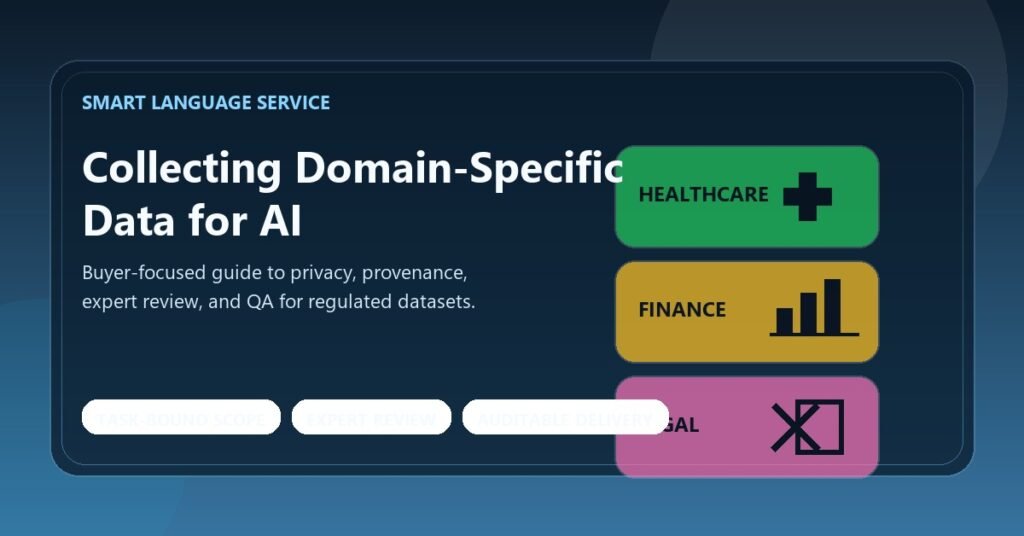
Why domain-specific data collection for AI should be planned like an operational program
Domain-specific data collection for AI becomes difficult the moment a team moves beyond generic public text and starts training or evaluating models for real decisions. A healthcare assistant cannot rely on loose medical phrases scraped from the open web. A finance workflow cannot treat every spreadsheet, transaction note, and compliance memo as interchangeable. A legal tool cannot perform reliably if clauses, citations, privilege rules, and matter context are mixed without structure. In each case, the buyer is not simply collecting more data. The buyer is building evidence that the dataset is fit for a narrow business task.
This is why enterprise AI teams should treat domain data collection as an operating program rather than a sourcing line item. The dataset has to reflect the language, document structure, sensitivity level, and review standard of the target workflow. If those constraints are vague, vendors may deliver files that look large on paper but are too noisy, too risky, or too weakly documented to support production use.
For healthcare, finance, and legal AI, the same three mistakes appear repeatedly. Teams define the domain too broadly, they underestimate review requirements, and they leave compliance questions until the end. A better approach starts by scoping the exact use case, designing collection rules around that use case, and proving data quality with traceable review.
Start with the task boundary, not the industry label
Healthcare, finance, and legal are not useful collection scopes by themselves. They are umbrellas covering many different workflows. A dataset for clinical summarization is different from one for patient support chat, prior authorization review, adverse event detection, or multilingual medical translation QA. In finance, fraud review, KYC document processing, policy question answering, credit risk support, and investor communications all require different evidence. In legal work, contract clause extraction, intake triage, litigation summarization, and multilingual due diligence review should never share one generic collection brief.
The first deliverable should therefore be a task map. Define what the model must read, what output it must produce, which languages matter, which errors are unacceptable, and which downstream human role will rely on the result. This task map determines whether the project needs conversations, PDFs, tables, handwritten forms, audio, policy manuals, statutes, or domain-specific terminology lists. It also tells the collection team what should be excluded.
Task-bound scoping makes vendor evaluation easier. If a supplier cannot explain how it separates source types, tracks provenance, or distinguishes production-critical examples from background reference material, the buyer should expect downstream rework. The discipline described in our guides to multilingual text data collection for LLM evaluation and AI data collection partner selection matters even more when the subject matter is regulated or liability-sensitive.
Healthcare data collection needs privacy design and clinical context together
Healthcare AI projects are often described as privacy problems first, but privacy is only half the challenge. Protected health information, consent restrictions, retention limits, and regional regulation are critical, yet a fully de-identified dataset can still be operationally weak if it loses the context clinicians need. Medication names, dosage patterns, visit summaries, symptom descriptions, coding conventions, and discharge instructions all carry meaning that depends on document type and workflow stage.
Buyers should decide early whether the model is expected to support administrative routing, patient communication, medical transcription, coding assistance, literature review, or internal quality review. Those use cases require different inputs and different review talent. A dataset for patient message triage should include realistic questions, abbreviations, escalations, and multilingual variants. A dataset for medical document extraction needs structured fields, domain taxonomy, and consistent annotation rules. A dataset for audio workflows may also need the consent, metadata, and validation controls covered in our voice data collection consent and privacy checklist.
Healthcare review also needs tiering. Not every sample requires a physician, but high-risk examples often require domain-trained validators who understand terminology, ambiguity, and what constitutes a harmful omission. If review roles are not separated clearly between de-identification, annotation, and clinical verification, teams may think the data is compliant while still missing the business standard for safe use.
Finance datasets fail when document logic and time sensitivity are ignored
Financial AI systems operate on documents and events whose meaning changes with timing, source authority, and policy context. A transaction description alone may be insufficient without merchant metadata, account type, dispute status, or reporting period. A compliance question-answer set may be useless if the underlying policy version is not tracked. A risk model support dataset can drift quickly if historical materials remain in circulation after rules or products change.
That means finance data collection should be versioned from the start. Buyers should capture document date, jurisdiction, business line, product family, source system, and approval state wherever lawful and relevant. Review guidelines should explain how to handle stale materials, templated language, duplicated statements, and mixed-use documents that combine marketing copy with regulated disclosures.
Specialized review is also essential. Fraud patterns, KYC terminology, lending language, and insurance claims language do not all behave the same way. A team that is strong in generic annotation may still miss the difference between a suspicious activity clue and ordinary account noise. For multilingual finance work, local market language matters as much as the English source. Product names, abbreviations, and customer complaint phrasing often vary by region, and that variation should be represented intentionally rather than treated as cleanup residue.
Legal AI data collection needs defensible provenance and matter-aware review
Legal data projects attract teams because documents appear abundant, but availability is not the same as usability. Contracts, pleadings, regulations, memos, discovery materials, compliance policies, and email chains all behave differently. A legal AI workflow depends on definitions, clause relationships, citations, matter stage, and the boundaries of privileged or confidential information. If those conditions are lost during collection, the model may learn patterns that are linguistically plausible but professionally unreliable.
A defensible legal dataset needs strong provenance records. Buyers should know whether a sample came from a public filing, an internal template, a client-approved synthetic scenario, or a redacted matter archive. They should also know which versions were reviewed, which confidentiality rules applied, and whether citations or clause labels were normalized. A contract extraction set without version control can quietly mix executed agreements with draft negotiation text and destroy label consistency.
Legal review should be matter-aware. Reviewers need to understand which annotations are clerical, which require legal reading skill, and which require attorney supervision. For cross-border work, language review should also account for jurisdiction-specific terminology rather than only literal translation. This is where many otherwise promising multilingual legal AI datasets break: they preserve words but lose procedural meaning.
Build a reviewer model that matches the risk in each layer
Many buyers ask whether they need subject-matter experts for every item. Usually the answer is no, but they do need a layered reviewer model. One layer may handle ingestion checks, format cleanup, duplicate control, and metadata normalization. Another may handle annotation against written rules. A narrower expert layer should calibrate difficult samples, edge cases, ambiguous labels, and release criteria. Without this structure, either expert time is wasted on trivial records or important cases are waved through by non-specialists.
The reviewer model should be written into the collection plan before volume starts. Define who can reject data, who can change taxonomy, who adjudicates disagreement, and which error categories block release. Measure disagreement by domain, label type, and source type instead of relying on one blended accuracy score. In regulated sectors, the wrong five percent matters more than the average ninety-five.
This layered approach is especially important when multiple languages are involved. Native-language reviewers may catch phrasing or terminology drift that domain reviewers miss, while domain reviewers may catch a risk that a linguistically fluent generalist would not flag. The best programs make those roles complementary instead of interchangeable.
Ask vendors for evidence, not only promises
A serious domain-specific data collection vendor should be able to show how the dataset was assembled, filtered, reviewed, and limited. Buyers should ask for sample schemas, annotation guides, rejection categories, provenance fields, QA checkpoints, privacy handling notes, and release reporting. If a vendor cannot explain how they separate source collection from expert review, the buyer is being asked to trust a black box.
Useful questions include:
- Which workflows inside healthcare, finance, or legal does the dataset explicitly support?
- How are source documents or utterances classified by type, date, and authority?
- Which steps use general QA reviewers, and which require subject-matter reviewers?
- How are redaction, consent, or confidentiality controls enforced and audited?
- How are multilingual variants, abbreviations, and market-specific terminology handled?
- What evidence package is delivered with the final dataset?
These questions improve procurement because they force the discussion away from raw volume and toward operational fit. A smaller dataset with strong provenance, expert review, and release documentation is often more valuable than a larger file dump that cannot survive audit.
Release package: what buyers should expect before accepting delivery
Before a dataset is accepted for healthcare, finance, or legal AI, the buyer should receive more than the data files themselves. The release package should include a collection brief, source eligibility rules, version information, sampling method, QA metrics, reviewer roles, rejection logs, and known limitations. For sensitive projects, the package should also state how confidentiality, consent, or de-identification controls were applied and tested.
The dataset should be inspectable at the slice level. Buyers should be able to review examples by document type, language, domain label, risk tier, and reviewer outcome. This is where many collection programs reveal whether they were built for production or only for one-time delivery. If the team cannot explain what proportion of the dataset came from each source class or how high-risk samples were reviewed, the acceptance decision is being made with incomplete information.
For adjacent planning, see our posts on how to build a multilingual dataset for customer support AI, audio data validation, and data labeling project management.
How Smart Language Service supports domain-specific AI data programs
Smart Language Service supports domain-specific data collection for AI across multilingual sourcing, domain-aware annotation, expert review coordination, privacy-sensitive handling, terminology control, and delivery QA. We help teams define the workflow boundary first, then build collection and validation steps that fit the actual risk of the use case. That includes healthcare communication data, finance operations content, legal and compliance materials, speech and text workflows, and cross-market language coverage.
The core principle is simple: domain AI does not fail only because a model is weak. It often fails because the dataset was collected without enough structure, evidence, or review discipline. When the collection program reflects domain reality from the start, model evaluation becomes more honest and production deployment becomes easier to defend.