Why consent matters in voice data collection
Voice data collection is essential for building speech recognition, voice assistant, call analytics, and conversational AI systems. But voice is not just another data format. A recording can reveal language, accent, age range, location clues, background environment, health conditions, emotions, and sometimes names or other personal information. That makes consent and privacy planning a core part of the project, not an administrative detail.
For buyers, the biggest risk is assuming that a vendor can collect voice data first and solve compliance questions later. In reality, consent language, participant records, storage rules, anonymization, and deletion procedures should be defined before recruitment starts. If these pieces are unclear, the dataset may become difficult to use, difficult to audit, or unsuitable for model training in regulated business environments.
Start with the purpose of the dataset
A strong voice data collection project begins with a clear use case. Are you collecting read speech for ASR training, spontaneous conversations for dialogue systems, call center audio for quality analysis, or wake-word recordings for a device? Each purpose affects the consent form, participant instructions, metadata requirements, and review process.
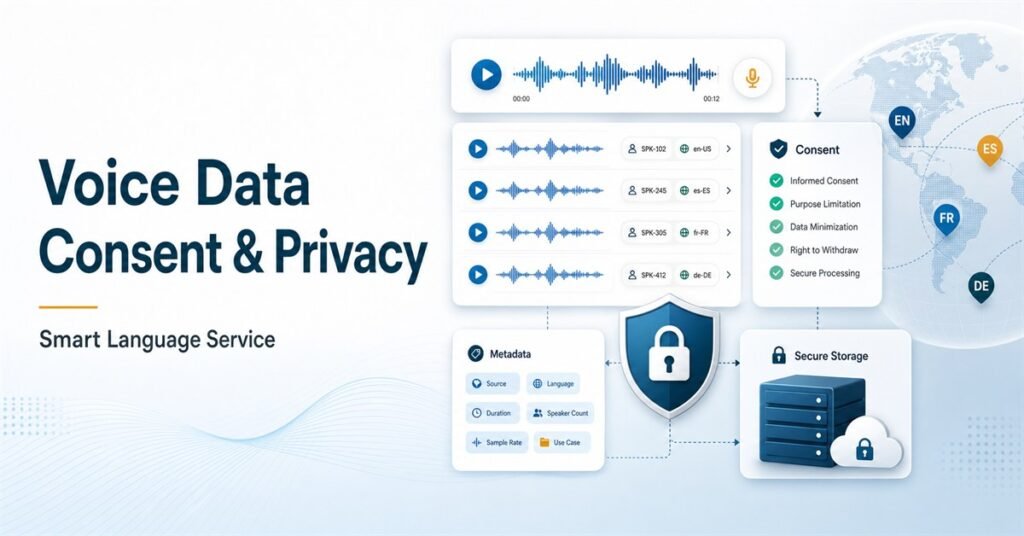
The consent statement should explain what will be recorded, why it is being collected, how the data may be used, whether it may be used for AI model training, and whether it may be shared with processors, reviewers, or technology partners. Participants should not have to guess whether their voice will be used only for one test or for future model improvement.
Define participant rights clearly
Good consent is specific, understandable, and traceable. Participants should know whether they can withdraw, how long withdrawal is possible, who to contact, and what happens to recordings that have already been processed. If the project involves minors, employees, contractors, medical contexts, or sensitive topics, the consent process may need additional safeguards.
Buyers should also ask vendors how consent records are stored. A dataset without reliable consent documentation can become a liability. Each recording should be traceable to a valid consent record without exposing unnecessary personal information to annotation or review teams.
Control what metadata is collected
Metadata is useful for speech AI projects. Language, dialect, age range, gender, device type, recording environment, and region can help teams evaluate coverage and model performance. But metadata can also increase privacy risk if it becomes too detailed or is combined with identifiable information.
A practical rule is to collect only the metadata needed for the project objective. If city-level location is not required, region-level information may be enough. If exact age is not required, age ranges may be safer. The buyer and vendor should agree on the metadata schema before recruitment begins.
Plan storage, access, and security
Voice recordings should be stored in controlled systems with clear access permissions. Buyers should ask who can access raw audio, who can access transcripts, who can export files, and how access is logged. For cross-border projects, storage location and data transfer rules may also matter.
Security planning should include encryption, limited access, secure transfer methods, retention periods, and deletion rules. It should also define what happens when a participant withdraws or when the project ends. These details are easier to manage when they are part of the project design from day one.
Anonymization and redaction need realistic expectations
Voice data can be difficult to anonymize completely because the voice itself may be identifying. Removing names from transcripts is useful, but it does not make raw audio anonymous. Some projects may require redaction of personally identifiable information, speaker ID separation, or removal of sensitive segments.
Buyers should be clear about what level of anonymization is expected and what is technically realistic. The vendor should explain whether redaction applies to audio, transcript, metadata, or all three. This avoids misunderstandings when the dataset is delivered.
What to ask a voice data vendor
Before starting a voice data collection project, buyers should ask practical questions: What consent template will be used? How are participants recruited and verified? How are consent records linked to recordings? What metadata is collected? Where is the data stored? Who can access it? How are withdrawals handled? What quality checks confirm that recordings match the required consent and project scope?
These questions are not just legal formalities. They determine whether the dataset can be trusted, reused, audited, and delivered without avoidable delays.
How Smart Language Service supports privacy-aware voice data projects
Smart Language Service helps AI teams design voice data collection workflows that balance dataset usefulness with consent, privacy, and operational control. We support participant recruitment, multilingual project instructions, metadata planning, recording quality checks, transcription, annotation, and dataset validation.
For teams building speech AI across languages and markets, privacy-aware planning reduces risk and improves dataset reliability. When consent and data handling are built into the workflow, buyers can move faster with more confidence.