
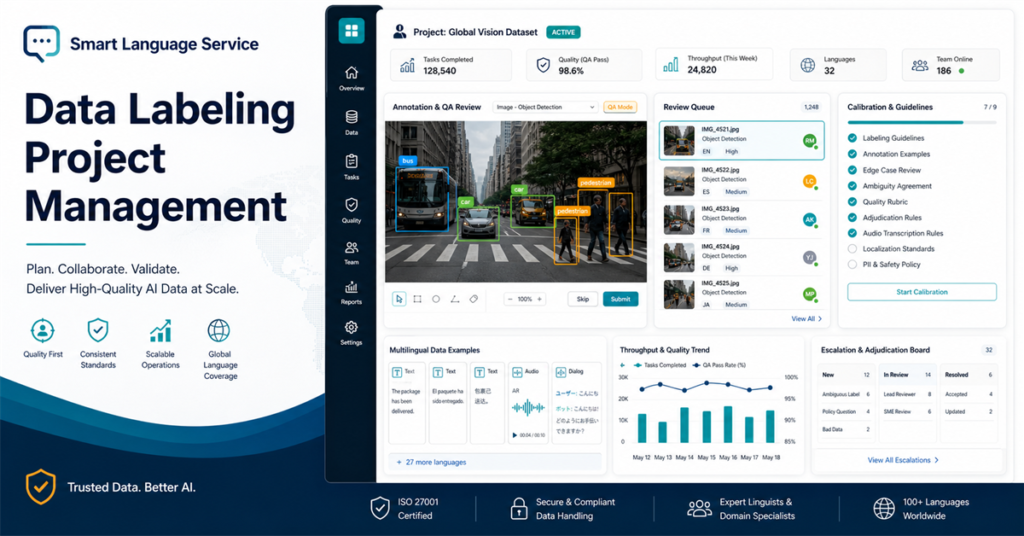
Why data labeling project management matters
Data labeling project management is the operating system behind a reliable annotation program. Large annotation teams can produce high volume quickly, but volume alone does not create useful AI training data. Without clear guidelines, calibration, review rules, throughput tracking, and escalation paths, a dataset can become inconsistent even when every individual annotator is trying to do good work.
The challenge grows with scale. More annotators mean more interpretations of the same instruction. More languages mean more edge cases. More task types mean more opportunities for label drift. If the project manager only tracks how many items were completed, quality problems may stay hidden until model training or buyer review.
Good project management turns annotation into a controlled production workflow. It defines what “correct” means, measures whether the team is still aligned, and creates a feedback loop before inconsistency spreads across the dataset.
Start with guidelines that are usable, not only complete
Annotation guidelines are not legal documents. They must be detailed enough to resolve common cases, but practical enough for annotators to use during production. A strong guideline explains the project objective, label definitions, positive and negative examples, edge cases, decision hierarchy, screenshot or audio examples, and the rule for “uncertain” items.
The most important section is usually the boundary between similar labels. If two sentiment classes, object categories, intent labels, or transcription conventions overlap, annotators need side-by-side examples. A definition without examples often creates different interpretations across teams.
Guidelines should also define what not to label. Exclusions, low-quality inputs, privacy-sensitive content, duplicates, mixed-language content, and ambiguous cases need handling rules. If these rules are missing, annotators will improvise, and improvisation becomes inconsistency.
Calibrate before production volume increases
Calibration is the process of making sure reviewers and annotators apply the same standard. Before a large rollout, assign the same sample to multiple annotators, compare agreement, discuss disagreements, and update the guideline. This small step prevents expensive rework later.
Calibration should continue during production. New annotators need onboarding batches. Existing teams need refreshers when rules change. Reviewers need their own calibration because inconsistent reviewers can create more confusion than inconsistent annotators. A reviewer who accepts one interpretation today and rejects it tomorrow damages trust in the process.
Track agreement by label, language, annotator group, and task type. Overall agreement can look healthy while one important class performs poorly. For example, “neutral” sentiment may be easy, while “mixed intent” or “partially visible object” creates repeated disagreement. These weak spots deserve targeted examples and additional review.
Design review rules before errors appear
Review strategy should match the risk of the task. Some projects need 100% review, especially at the start or when labels are safety-critical. Others can use sampled review once the team is stable. The key is to define review rates, sampling logic, reviewer authority, acceptance thresholds, and rework triggers in advance.
Sampling should not be purely random. Include high-risk categories, rare labels, new annotators, low-confidence items, difficult languages, unusual file sources, and batches with abnormal speed. Random sampling estimates average quality; targeted sampling finds the failures that average quality hides.
When errors are found, record the type of error, not only the pass or fail result. A mislabeled object, missing attribute, wrong span boundary, transcription punctuation issue, privacy violation, and unclear guideline are different problems. Each requires a different fix.
Control throughput without rewarding low-quality speed
Throughput metrics are useful only when read together with quality. Items per hour, completed batches, review backlog, rework rate, rejection rate, and turnaround time should be tracked at the same time. If speed rises while disagreement and rework rise, the project is not becoming more efficient; it is moving quality costs downstream.
Set realistic productivity benchmarks by task type. Bounding boxes, polygons, entity spans, audio segmentation, sentiment labels, and multilingual transcription do not have the same effort profile. A single productivity target across all tasks encourages shortcuts and unfair comparisons.
Use dashboards to detect anomalies. Very fast annotators may be excellent, but they may also be skipping details. Very slow annotators may be struggling with instructions or receiving harder items. The project manager should investigate patterns instead of assuming the number explains itself.
Build an escalation system for ambiguous cases
Ambiguity is normal in data annotation. The problem is not that annotators ask questions; the problem is when questions are answered privately and never added to the shared standard. A good escalation system turns uncertainty into guideline improvement.
Create clear channels for edge cases: examples that do not fit a label, source files with quality defects, privacy-sensitive content, conflicting client instructions, and repeated reviewer disagreement. Assign owners and response times. If the same question appears more than once, add it to the guideline or FAQ.
Adjudication is especially important when multiple reviewers disagree. One senior reviewer or domain expert should make final calls on disputed cases, and those decisions should become training examples. This keeps the project standard from fragmenting across teams.
Manage multilingual and cross-cultural annotation carefully
Large annotation programs often involve multiple languages and markets. Directly applying one language’s examples to another can create label drift. Sentiment, intent, toxicity, politeness, humor, and cultural references may not map neatly across languages.
For multilingual work, use native reviewers and language-specific examples. Keep the global taxonomy consistent where needed, but allow local notes that explain market-specific interpretation. Track quality by language rather than averaging all languages together. A high overall score can hide a weak language pair.
For speech and text data, metadata consistency is also part of quality. Language, locale, speaker ID, source channel, consent status, and task prompt must be reliable. Annotation cannot fix a broken manifest; project management needs to connect labeling QA with data operations.
Use feedback loops instead of end-stage rescue
Waiting until final delivery to discover quality issues is the most expensive approach. Build checkpoints: pilot review, first production batch review, weekly calibration, targeted audits, and final release QA. Each checkpoint should produce decisions: update the guideline, retrain a group, increase review rate, reject a source, or approve scaling.
Feedback should be specific and example-based. Telling annotators to “be more careful” is not useful. Show the incorrect label, the correct label, the rule that applies, and the reason. When the same error appears repeatedly, fix the process, not only the person.
Client feedback should also be structured. Ask clients to mark disagreement categories and provide final decisions on edge cases. Convert their feedback into guideline updates and reviewer calibration material. This prevents the project from repeating the same debate batch after batch.
Release checklist for consistent annotation
- Confirm the guideline includes label definitions, examples, exclusions, and edge cases.
- Run calibration before scaling and after every major rule change.
- Track agreement by label, language, task type, reviewer, and annotator group.
- Use targeted QA sampling for rare, risky, new, and abnormal items.
- Record error types and root causes, not only pass or fail.
- Monitor throughput together with rework, disagreement, and rejection rates.
- Keep escalation decisions visible and update the shared standard.
- Perform final release QA with a versioned report and known limitations.
Related reading: our guide to annotation guidelines explains how to reduce rework at the instruction stage, and our image annotation QA guide covers bounding boxes, polygons, and reviewer checks in more detail.
How Smart Language Service helps
Smart Language Service supports data labeling projects with guideline preparation, multilingual annotator teams, reviewer calibration, production tracking, escalation workflows, and QA reporting. We work across image, text, audio, transcription, and multilingual data workflows, with project management designed for consistency rather than only speed.
For buyers, the benefit is simple: fewer surprises at delivery, clearer evidence for dataset acceptance, and a labeling process that can scale without losing the standard that made the pilot successful.