Why a multilingual dataset for customer support AI needs more than translated examples
A multilingual dataset for customer support AI should not be built by translating one English intent list into other languages and calling the project complete. Real customers do not speak like translated templates. They use local product names, spelling variations, mixed languages, shortcuts, complaints, urgency signals, and market-specific ways of asking for help. If the dataset does not reflect those patterns, the model may look accurate in a test file but fail when it meets real support conversations.
This matters for chatbots, ticket routing, voice assistants, knowledge base search, agent assist, sentiment analysis, and multilingual quality monitoring. Customer support AI is judged in moments of friction: when a user is confused, angry, in a hurry, or describing a problem with incomplete information. The dataset therefore has to represent practical language behavior, not only clean examples.
For buyers, the goal is to create a dataset that helps the AI understand intent, context, escalation risk, and local language habits across markets. That requires careful scope design, native-language collection, annotation guidelines, QA, and privacy-aware operations. The same discipline used in multilingual text data collection for LLM evaluation and data annotation quality control also applies to support AI datasets.
Start with support workflows before collecting language data
The strongest multilingual dataset for customer support AI starts with the support workflow, not the language list. Teams should first define what the AI is expected to do. Is it routing tickets to the right queue, answering common questions, detecting churn risk, summarizing conversations, recommending agent responses, or identifying when a human must take over?
Each task requires different data. Intent classification needs representative utterances and clear labels. Agent assist needs customer messages, relevant context, and useful response patterns. Escalation detection needs examples of frustration, urgency, repeated contact, billing risk, safety concerns, or compliance-sensitive requests. A voice support model may also need transcripts, timestamps, speaker labels, and noise-related metadata.
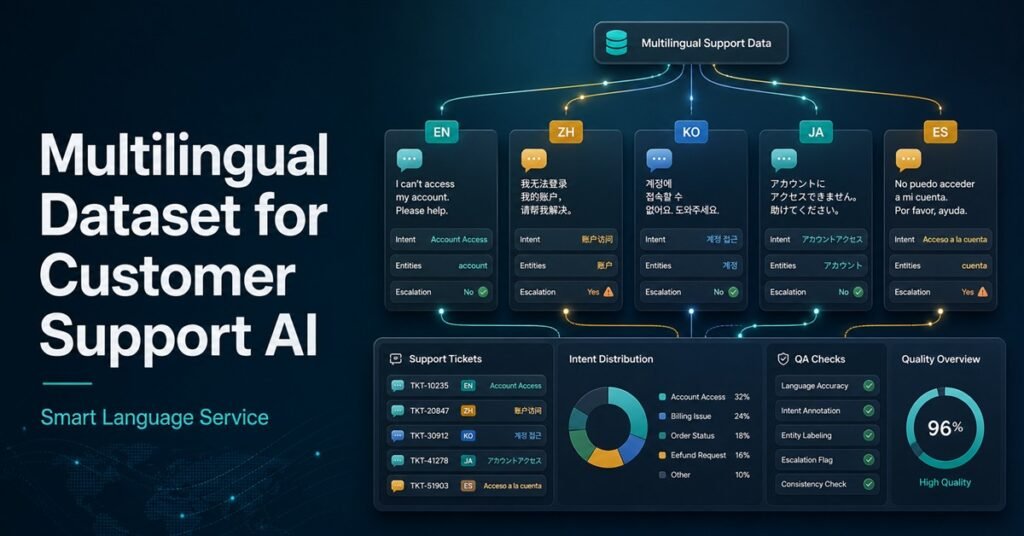
Once the workflow is clear, language coverage becomes easier to plan. A company may need English, Chinese, Spanish, Japanese, and Korean, but the same intent may not have the same frequency or wording in every market. Refund questions, delivery complaints, onboarding issues, payment failures, and technical troubleshooting can vary by product, channel, and customer behavior. The dataset should reflect those differences instead of forcing every market into the same English-shaped structure.
Define intents, entities, and escalation labels carefully
Intent labels are the backbone of many customer support AI datasets. However, labels can become weak if they are too broad, too overlapping, or too disconnected from real operations. A label such as technical issue may be too vague if the support team needs to separate login failure, integration problem, file upload error, account permission issue, and API downtime.
A practical label system should match business action. If two customer messages require the same support workflow, they may belong together. If they require different teams, priorities, or knowledge base content, they may need separate labels. This prevents the dataset from becoming linguistically interesting but operationally useless.
Entities are equally important. Product names, order IDs, account types, regions, device models, error codes, subscription plans, and dates may need to be captured consistently. For multilingual support, entity handling must include local spelling, transliteration, abbreviation, and mixed-language behavior. A customer may use an English product name inside a Spanish or Japanese sentence, and the dataset should not treat that as noise.
Escalation labels should also be defined before collection begins. Buyers should decide how to mark refund threats, legal concerns, safety risks, angry tone, repeated failed attempts, VIP accounts, and urgent business impact. These labels help the AI support the customer experience instead of merely classifying topics.
Collect native examples instead of relying only on translation
Translation can help expand seed examples, but it should not be the only source of a multilingual dataset for customer support AI. Translated examples often preserve the structure of the source language. They may be grammatically correct but still unlike real customer messages.
Native collection brings in the details that matter: informal wording, common typos, local idioms, channel-specific phrasing, abbreviations, politeness patterns, and frustration signals. It also reveals what customers in each market actually complain about. For example, a delivery issue may be described differently in a marketplace chat, a mobile app review, a WhatsApp-style message, or a formal enterprise support ticket.
A balanced approach is often best. Teams can start with a structured intent framework and seed examples, then collect or rewrite native-language examples around realistic support scenarios. For sensitive domains, collection should use synthetic or anonymized scenarios instead of exposing real customer data. The key is that every language should sound like it came from actual users in that market.
Include messy language because support conversations are messy
Customer support AI often fails when the training data is too clean. Real users make spelling mistakes, switch languages, paste screenshots or error text, repeat themselves, use slang, omit context, and send short messages such as not working, still waiting, or why charged twice. A dataset that only contains polished sentences will not prepare the model for these cases.
A useful multilingual dataset should include short queries, long complaints, incomplete messages, duplicate messages, emotional language, and ambiguous requests. It should also include near-duplicate intents that are easy to confuse, such as cancel subscription versus refund payment, or password reset versus account recovery. These examples help reveal whether labels and guidelines are strong enough.
For voice or transcript-based support AI, messiness also includes background noise, interruptions, speaker overlap, filler words, and inconsistent timestamps. The principles overlap with transcription services for AI training data: structure matters because downstream AI systems depend on it.
Build QA into the dataset from the beginning
Quality control should not be saved for the final delivery. A multilingual dataset for customer support AI needs QA at every stage: intent design, language collection, annotation, review, and final validation. If the first batch reveals label confusion, unclear examples, or weak market fit, the guideline should be corrected before full-scale production.
Reviewer calibration is especially important. Native reviewers should compare the same examples and discuss disagreements. If reviewers cannot consistently distinguish two labels, the model will probably struggle as well. QA should track label agreement, entity consistency, language naturalness, duplicate patterns, and whether examples match the intended support workflow.
Buyers should also ask for targeted sampling. Random checks are useful, but high-risk categories need extra attention: refunds, legal complaints, safety issues, account access, payment failures, and angry customers. These are the cases where a wrong model decision can damage trust quickly.
Protect privacy and compliance during data collection
Support data can contain names, addresses, phone numbers, emails, payment details, health information, account identifiers, and emotional complaints. A multilingual dataset for customer support AI should therefore be designed with privacy controls from the start.
Teams should decide whether the dataset will use real historical tickets, anonymized tickets, synthetic examples, recruited scenario writing, or a hybrid approach. If real data is involved, personal information should be removed or masked according to the project policy. Access control, consent, retention period, and audit records should be documented.
This is not only a legal concern. Privacy planning also improves dataset usability. Clean metadata, clear anonymization rules, and auditable sources make it easier for AI, legal, product, and operations teams to trust the dataset. For buyers that already manage voice data consent and privacy, the same mindset should extend to text-based support data.
Questions buyers should ask before starting a multilingual support AI dataset
Before approving a vendor or internal production plan, buyers should ask practical questions that reveal whether the dataset will be useful in real operations.
- Which support workflows will the AI improve, and how will each workflow use the dataset?
- Are intents defined by business action, not only by topic similarity?
- Which entities, error codes, account details, and product terms must be captured?
- How will each language receive native examples instead of only translated examples?
- How will code-switching, typos, slang, short messages, and angry tone be represented?
- What QA metrics will track label agreement, naturalness, and escalation risk?
- How will personal or sensitive information be removed, masked, or avoided?
These questions matter because multilingual customer support AI is a production system. The dataset must connect language behavior to service outcomes.
How Smart Language Service supports multilingual customer support AI datasets
Smart Language Service helps teams build multilingual datasets for customer support AI across text, speech, transcription, annotation, translation, and QA workflows. We support intent design, native-language example creation, entity annotation, escalation labeling, multilingual reviewer management, and privacy-aware delivery.
For AI teams, customer support leaders, and localization managers, the strongest dataset is not the biggest spreadsheet of examples. It is the dataset that captures how real customers ask for help, how support teams need to respond, and how quality can be measured across markets. When workflow design, native language coverage, annotation rules, and QA are aligned, multilingual support AI becomes more reliable for both customers and internal teams.