
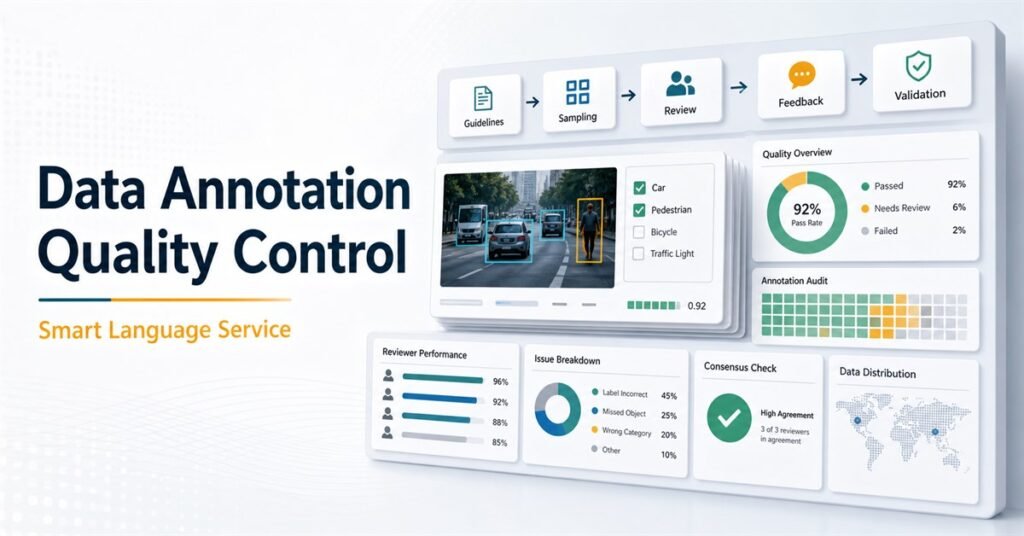
Why data annotation quality control matters
Data annotation quality control is one of the most important parts of building useful AI training data. A model can only learn from the structure, labels, and examples it receives. If labels are inconsistent, guidelines are unclear, or reviewers only check the final batch, the project may look complete while the dataset still carries hidden quality problems.
For AI teams, annotation quality is not only about correcting individual mistakes. It is about designing a workflow that prevents avoidable errors, finds ambiguous cases early, and keeps large annotation teams aligned over time. This is especially important for multilingual projects, domain-specific datasets, and tasks where label definitions depend on context.
Quality starts before labeling begins
A stable annotation project begins with clear task design. Before assigning work to annotators, the project team should define the label taxonomy, acceptance criteria, edge cases, rejection rules, and examples for each label. Good guidelines should explain not only what the correct answer is, but why one label is preferred over another in difficult cases.
Pilot annotation is also essential. A small pilot batch helps reveal unclear instructions, missing labels, confusing examples, and unrealistic throughput assumptions. If a pilot batch shows disagreement between annotators, that is not a failure. It is useful evidence that the guidelines need refinement before the project scales.
Reviewer calibration prevents inconsistent decisions
Reviewer calibration is often overlooked. If reviewers apply different standards, the final dataset can become inconsistent even when annotators work carefully. Before full production, reviewers should annotate and review the same sample set, compare decisions, and agree on how to handle difficult cases.
Calibration should continue during the project. New edge cases appear as the dataset grows, and these cases should be added to the guideline rather than solved privately by one reviewer. This creates a living quality system where every decision improves the next batch.
Sampling and feedback loops reduce rework
A practical quality control workflow should combine random sampling, targeted sampling, and issue-based review. Random sampling gives a general picture of quality. Targeted sampling focuses on high-risk labels, new annotators, or difficult content types. Issue-based review tracks repeated errors and turns them into concrete feedback.
Fast feedback matters. If annotators receive feedback only after thousands of items are completed, the same mistake may already have been repeated across the dataset. Short review cycles help teams correct direction early and reduce expensive rework.
Metrics should support decisions, not hide problems
Accuracy scores and agreement rates are useful, but they should not be the only quality signals. A high agreement rate may simply mean the task is easy, while a low agreement rate may indicate ambiguous guidelines rather than poor annotator performance. Useful metrics include label distribution, reviewer override rate, error type frequency, throughput changes, and unresolved edge cases.
The goal is to understand why quality changes. When metrics are connected to real examples and reviewer notes, project managers can decide whether to update guidelines, retrain annotators, adjust scope, or add another review layer.
How Smart Language Service supports annotation QA
Smart Language Service helps AI teams build annotation workflows that are practical, measurable, and scalable. We support guideline design, multilingual annotation teams, reviewer calibration, quality sampling, feedback management, and final dataset validation. Our experience across language services and AI data projects helps us handle tasks where language, context, and cultural nuance affect label quality.
For teams preparing speech, text, image, or multilingual datasets, strong quality control should be built into the project from the beginning. When QA is part of the workflow, not just a final checkpoint, the dataset becomes more reliable and the model training process becomes easier to trust.