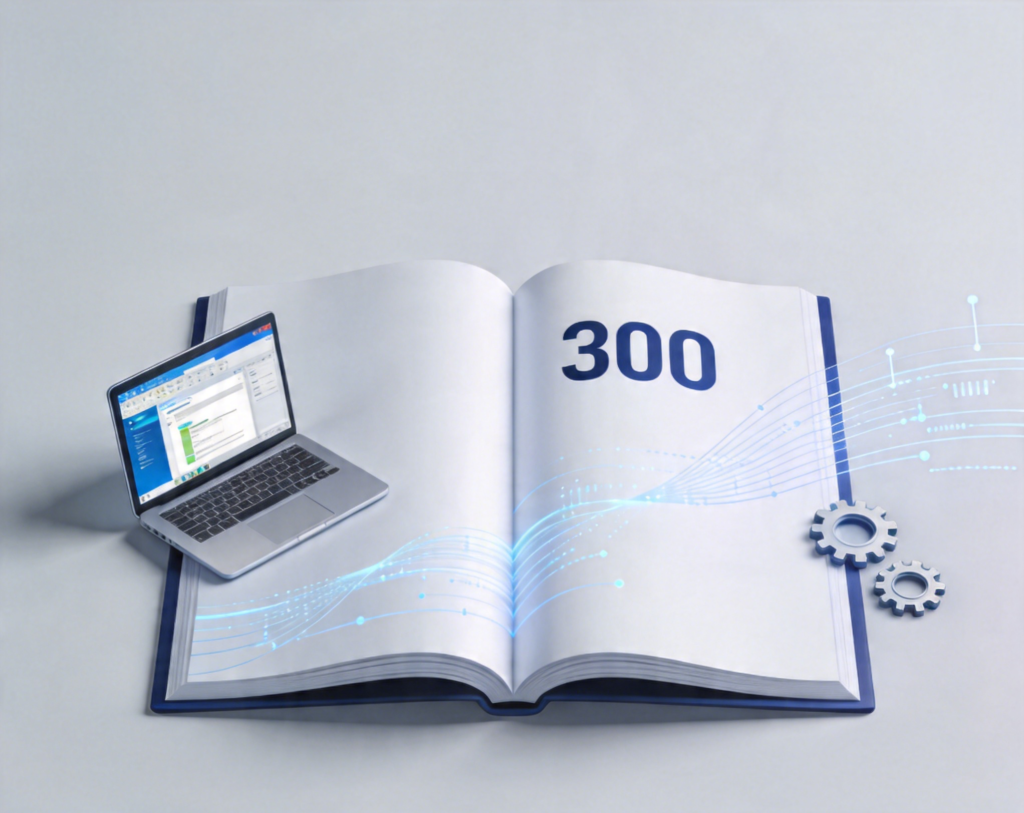
A client sent us a 300-page technical manual in a non-standard format with no editable source files. Here is how we handled it — and delivered on time.
pages
languages
business days
missed deadlines
Introduction
Not every translation project arrives in a clean, editable Word document. Some of the most important documents — the ones clients need translated most urgently — come in formats that were never designed for translation: legacy software exports, scanned PDFs with mixed layouts, proprietary engineering formats, or documents built in tools that no longer exist.
This is the story of one such project. A US-based manufacturing client needed a 300-page technical maintenance manual translated into four languages. The catch: the manual existed only as a locked PDF with embedded images, mixed column layouts, and no source files. Here is what we did, how we did it, and what it can tell you about choosing a translation partner for complex document work.
The Challenge
The client was a US manufacturer preparing to expand operations into Germany, Japan, Brazil, and South Korea. Their maintenance manual — 300 pages covering installation, operation, diagnostics, and safety procedures — needed to be in all four languages before equipment was shipped to each country.
The problem was the format. The manual had been produced in a legacy desktop publishing system that the client no longer had access to. What they could provide was a high-resolution PDF scan — formatted with two- and three-column layouts, diagrams with embedded text labels, footnotes, warning boxes, and equipment specification tables.
The specific obstacles we faced:
- No editable source file — every page had to be reconstructed from the PDF.
- Embedded text in diagrams — safety labels and part names were part of the images, not separate text layers.
- Mixed column layouts — some pages used one column, others two or three, with no consistent grid.
- Four target languages with different text expansion rates — German text typically runs 25–35% longer than English, which would break every layout.
The client’s deadline was firm: 18 business days. Equipment shipping was already booked.
Our Approach
We divided the project into four parallel workstreams, each with a dedicated lead. Here is the step-by-step process:
| Phase | What we did | Why it mattered |
|---|---|---|
| 1 — Document reconstruction | Rebuilt all 300 pages in InDesign from the PDF using OCR and manual cleanup | Created an editable master that could be updated for all 4 languages without re-doing layout from scratch |
| 2 — Diagram text extraction | Isolated all text labels in diagrams; exported as separate translation units | Allowed translators to work on diagram labels independently, then re-embed them at the correct size |
| 3 — Translation & terminology | Assigned domain-specialist translators for each language; created a shared 420-term glossary for the project | Ensured consistent use of technical terminology across all languages and pages |
| 4 — Layout adaptation | Adjusted column widths, font sizes, and line spacing per language to accommodate text expansion | German pages needed up to 30% more horizontal space; Japanese required font substitution for legibility |
| 5 — Quality review | Two-pass review: linguist QA then layout QA by a separate reviewer | Caught both translation errors and layout breaks before delivery |
Step 1 — Document Reconstruction
Because the client had no source files, we could not simply open the document and start translating. We used a combination of optical character recognition (OCR) software and manual cleanup to extract all text from the PDF, then rebuilt the document page by page in Adobe InDesign. This gave us a fully editable master file that could be updated in parallel for all four target languages without repeating the layout work four times.
Rebuilding a 300-page document is time-consuming, but it is almost always faster and less error-prone than translating directly in a PDF. Direct PDF translation tools frequently introduce spacing errors, font substitutions, and formatting breaks that are invisible until print.
Step 2 — Diagram Text Extraction
Approximately 60 diagrams across the manual contained embedded safety warnings, part names, and measurement labels. Because these were image elements rather than text layers, standard translation tools would have ignored them entirely. We extracted each diagram, catalogued all text labels, translated them as part of the main translation batch, and then re-embedded them at the correct position and size in the final layouts. For Japanese and Korean, this also required switching to CJK-compatible fonts that maintained readability at the small sizes used inside diagrams.
Step 3 — Glossary Development and Translation
Before translation began, our project manager worked with the client to build a 420-term master glossary covering all equipment names, process terminology, safety classifications, and standard abbreviations. All four translation teams worked from this shared reference. This is standard practice on technical projects but is often skipped by lower-cost providers — the result of skipping it is inconsistent terminology across sections, which in a maintenance manual can mean the difference between safe and unsafe operation.
Consistent terminology is not a style preference in technical documentation — it is a safety requirement. A part called a ‘pressure relief valve’ on page 12 cannot be a ‘safety release valve’ on page 187.
Step 4 — Layout Adaptation per Language
One of the most visible challenges in multilingual document translation is text expansion. English is a relatively compact language. German, for example, typically requires 25–35% more space for the same content. Portuguese and Spanish run 15–25% longer. Japanese and Korean are more compact but require different typographic conventions. For each language, our layout team adjusted column widths where possible, reduced font sizes within acceptable readability thresholds, tightened line spacing, and in some cases re-designed table layouts to accommodate the longer text without breaking the page structure.
The Result
All four translated manuals were delivered on day 18 — within the agreed timeline. Here is the final scorecard:
pages
languages
business days
missed deadlines
The client received five files: the rebuilt English master plus all four translated versions, each in InDesign source format with embedded fonts, and export-ready PDFs. The glossary was delivered as a separate reference document for future use.
The client reported zero translation-related issues during equipment installation in all four countries. The manuals were reviewed and approved by their local engineering teams without revision requests.
What This Project Can Tell You About Choosing a Translation Partner
- Source file availability changes the cost and timeline significantly. If you have editable source files for your documents, provide them. If you do not, expect a document reconstruction phase in the quote.
- Embedded text in images is a common oversight. Many clients assume their documents are ‘text only’ without realising that diagrams contain translated content too. A provider who does not ask about this will miss it.
- Glossary development is not optional for technical content. For any document where terminology consistency matters — manuals, legal contracts, regulatory filings — a project glossary should be built before translation starts.
- Text expansion planning prevents layout disasters. A translation that looks correct in Word can completely break a designed layout. Layout adaptation must be part of the scope, not an afterthought.
- Deadline reliability comes from project structure, not promises. We met an 18-day deadline on a 300-page, 4-language project because we ran parallel workstreams, not sequential ones. Ask your provider how they structure large projects.
Summary
- A non-standard format is not a reason to delay a translation project — it requires a structured approach.
- Document reconstruction, diagram text handling, glossary development, and layout adaptation are all distinct competencies that a provider must demonstrate.
- Consistent terminology in technical documents is a safety issue, not a style preference.
- The right partner will ask hard questions about your files before quoting — not after problems appear.
Tell us about your files, format, and deadline. We will review your project and give you a clear plan within 24 hours.
→ smartlangservice.com/contact/