
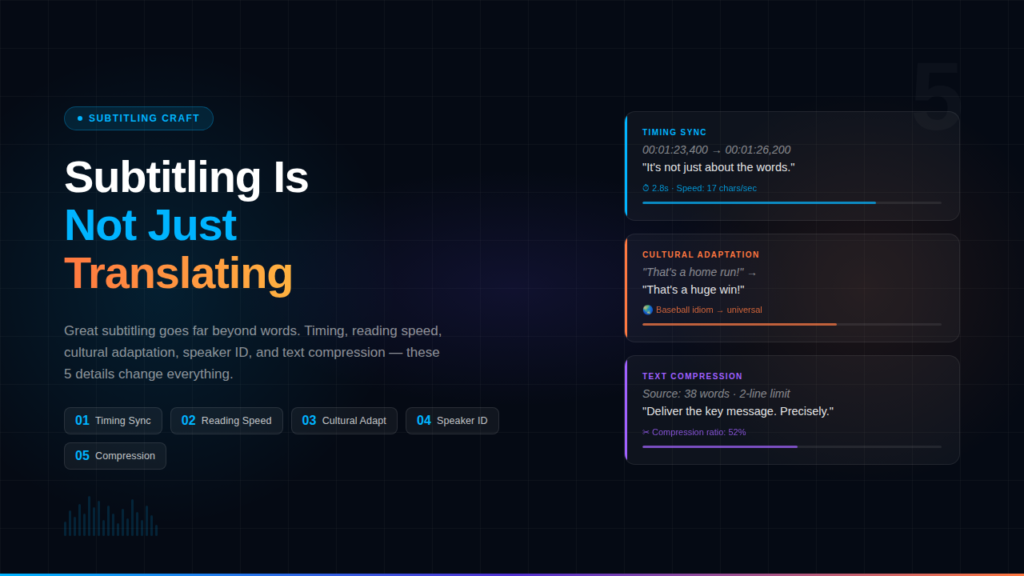
Subtitling ≠ Just Translating Captions: 5 Details That Change Everything
Introduction
If you've ever hired a translator to add subtitles to a video, you might have assumed it's simple: translate the dialogue, paste the text under the video, and you're done. That assumption is wrong — and it leads to bad subtitles that frustrate viewers and hurt your brand.
Subtitling is not the same as translating captions. Professional subtitling requires technical, linguistic, and cognitive skills that go far beyond translation. In this article, we break down 5 specific details that change everything.
Detail #1: Reading Speed Constraints
When you translate a document, readers can go at their own pace. Subtitles don't work that way. Viewers must read, watch the scene, and listen simultaneously — usually in 1–2 seconds per subtitle line.
Professional subtitlers measure reading speed in characters per second (CPS). The standard is 15–17 CPS for adult audiences, and only 12–14 CPS for children's content. A raw caption translation often exceeds 20 CPS, forcing viewers to choose between watching the video or reading the text. That's a failure.
Detail #2: Spotting and Timing (In/Out Cues)
Translators work with words. Subtitlers work with time. Every subtitle line has an "in cue" (when it appears) and an "out cue" (when it disappears). These must be precisely aligned with the audio.
Rules that don't exist in translation: no subtitle should cut across a shot change. No subtitle should stay on screen longer than 6 seconds or shorter than 1 second. Subtitles must not cover speakers' faces or critical on-screen information. A pure translator won't know these rules.
Detail #3: Condensation and Text Compression
Spoken language is messy: repetitions, false starts, fillers ("um", "well", "you know"). In written subtitles, all of that must go. But condensing text isn't just deleting words — it's preserving meaning, tone, and intent with fewer characters.
Example: a speaker says "Well, I guess what I'm trying to say is that we probably should consider maybe delaying the launch."
A raw translation keeps all that. A professional subtitle becomes: "We should consider delaying the launch." Same meaning. Half the reading time.
Detail #4: Speaker Identification and Sound Description
Translating captions ignores non‑speech information. Professional subtitling includes:
- Speaker labels when off-screen or ambiguous ([MAN], [ALICE])
- Sound effects in brackets ([door slams], [phone buzzes])
- Music descriptions for lyrics ([upbeat rock music])
These elements are essential for accessibility (deaf and hard‑of‑hearing viewers) and for narrative clarity. A caption translator rarely provides them.
Detail #5: Cultural and Visual Adaptation
Translation handles words. Subtitling handles words + image + culture. A direct translation might be correct but unusable because it doesn't fit the visual context.
Example: a character points to a sign in the background and says "That place". The original sign reads "Joe's Diner". A literal translation into another language might be too long to fit on screen while the character is still pointing. The subtitler must shorten without losing meaning — or restructure the line entirely. This never happens in document translation.
The 5 Details at a Glance
| # | Detail | Why It's Not "Just Translation" |
|---|---|---|
| 1 | Reading speed (CPS) | Viewers have 1–2 seconds per line; raw translations are too dense |
| 2 | In/out timing cues | Subtitles must align with shot changes and audio, not just words |
| 3 | Condensation | Spoken filler words must be removed without losing meaning |
| 4 | Speaker ID & sound effects | Essential for accessibility and clarity — translation ignores them |
| 5 | Cultural + visual fit | A correct translation may be too long or visually mismatched |
Why Most "Translation Agencies" Get Subtitling Wrong
Many general translation agencies treat subtitles as just another text format. They give your video to a translator who has never used subtitling software, never heard of CPS, and doesn't know that a subtitle cannot span a shot change. The result: technically "correct" subtitles that are unwatchable.
At Smart Language Service, we separate subtitling from translation. Our subtitlers are trained in timing, condensation, and visual context. We use professional tools (Aegisub, Subtitle Edit, Ooona) and follow global broadcast standards.
Summary
- Subtitling is not caption translation — it adds time, space, and visual constraints.
- Reading speed (CPS) determines whether subtitles are usable or exhausting.
- Timing cues must align with audio, shot changes, and on-screen action.
- Condensation preserves meaning with fewer characters.
- Speaker IDs and sound descriptions are required for accessibility.
Need professional subtitles for your video content?
Contact Smart Language Service for a free project consultation →