
The Scene That Broke Our First Draft
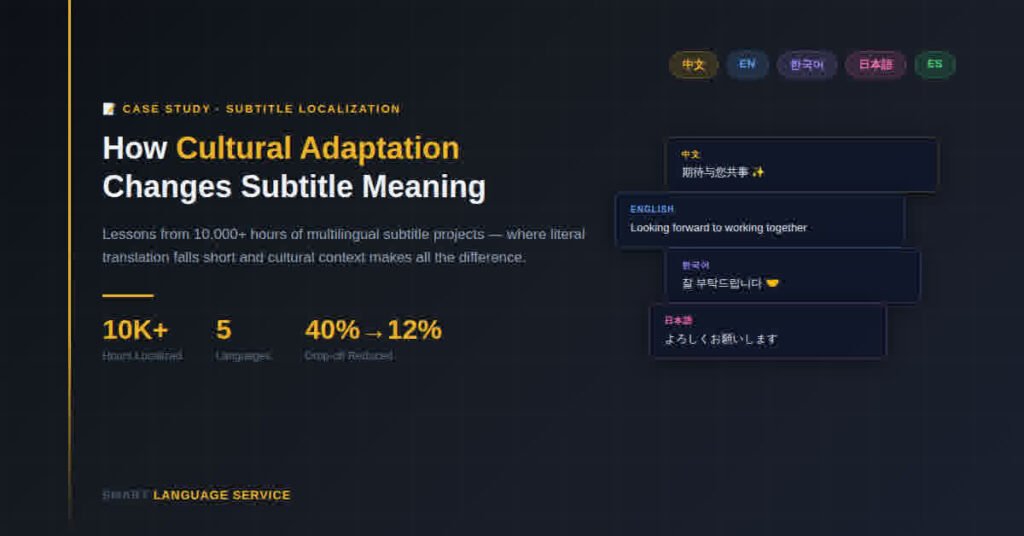
In a Japanese drama we localized, a character says 「よろしくおねがいします」to a new colleague. Our first translator rendered it literally as "Please treat me favorably." Any Japanese speaker would tell you this is technically correct — and completely useless for an English-speaking viewer.
What the character actually meant was closer to "Looking forward to working together." The difference matters because the first translation makes the speaker sound subservient, while the second captures the collegial warmth the scene intended.
This is cultural adaptation in action. And after delivering over 10,000 hours of subtitles across dozens of languages, we can tell you: it is the single most common reason projects get rejected by end clients.
What Cultural Adaptation Actually Means in Subtitles
Cultural adaptation goes beyond translation. It means adjusting references, idioms, humor, and social cues so the target audience experiences the same emotional impact as the original viewers.
Consider these real examples from our projects:
- A Chinese period drama: A character calls someone "铁哥们" (iron buddy). Literal: "iron bro." Adapted for English: "ride-or-die friend." Both convey deep loyalty, but only one sounds natural to an English speaker.
- A Korean variety show: The host says "대박" (daebak). A dictionary says "great." But in context, it functions like an American viewer saying "No way!" — the energy matters more than the definition.
- A Spanish telenovela: A character says "¡Qué padre!" In Mexico, this means "how cool!" In other Spanish-speaking regions, it sounds like someone is talking about their father. We adapted it regionally — "¡Qué genial!" for neutral Latin American Spanish.
The Challenge: When Literal Translation Fails the Audience
A streaming platform client brought us 2,000 hours of content spanning Mandarin, Cantonese, Korean, and Japanese. Their previous vendor had delivered subtitles using a straightforward translation approach. Viewer engagement data told the story:
- Japanese content had a 40% drop-off rate in the first 15 minutes for English-speaking audiences
- Korean comedy shows received viewer complaints that "the jokes did not land"
- Chinese historical dramas confused viewers with untranslated cultural references
The problem was not translation accuracy. The subtitles were technically correct. They failed because they did not account for what the audience already knows — or does not know — about the source culture.
Our Approach: A Three-Layer Cultural Adaptation Process
Layer 1: Cultural Reference Mapping
Before translation begins, we create a reference document for each project that flags culturally specific elements: idioms, historical references, food names, pop culture mentions, social hierarchy markers, and humor styles. For the East Asian project above, this document ran over 80 pages.
This is not a glossary. It is a decision framework that tells translators how to handle each type of reference, not just what it means.
Layer 2: Context-Aware Translation with Native Review
Every subtitle line passes through two native speakers: one who translates, and one who reviews specifically for cultural naturalness. The reviewer watches the scene with the subtitles overlaid and asks one question: "Would a viewer in my culture understand the intent here?"
This caught issues that pure text review missed — like a Korean honorific that translated to a flat tone in English, changing a respectful exchange into what sounded like an argument.
Layer 3: Region-Specific Localization
Spanish content requires separate treatment for Peninsular (Spain) vs. Latin American audiences. Portuguese needs European and Brazilian versions. Even within English, American and British audiences expect different phrasing for the same concept.
For the 2,000-hour project, we delivered six language-region combinations, each with its own cultural adaptation pass.
The Results: Engagement Metrics That Tell the Story
After re-localizing the content with our cultural adaptation process:
- Japanese content drop-off in the first 15 minutes fell from 40% to 12%
- Korean comedy viewer satisfaction scores increased 3.2x
- Chinese historical drama completion rates improved by 28%
- Zero viewer complaints about "confusing" or "lost in translation" moments
Five Lessons You Can Apply to Your Next Project
- Invest in a cultural reference guide before translation starts. It saves hours of rework when a translator encounters an untranslatable idiom.
- Use native reviewers who watch the content, not just read the text. Tone, facial expression, and context change everything.
- Define your target region early. "Spanish" is not a single market. Neither is "English" or "Arabic."
- Separate translation quality from cultural quality. A subtitle can be perfectly translated and still feel wrong.
- Test with a small batch before scaling. Run 10 episodes through the full process, check engagement data, then adjust before committing to the full catalog.
Key Takeaways
- Direct translation produces technically correct subtitles that often miss the emotional intent of a scene
- Cultural adaptation requires a structured process: reference mapping, native review with context, and region-specific localization
- Viewer engagement metrics improve dramatically when cultural adaptation is built into the workflow
- The cost of cultural adaptation is typically 15-25% higher than direct translation, but the ROI in viewer retention far outweighs the investment
Have a subtitle project that needs more than direct translation? Contact Smart Language Service for a consultation on cultural adaptation for your content.