
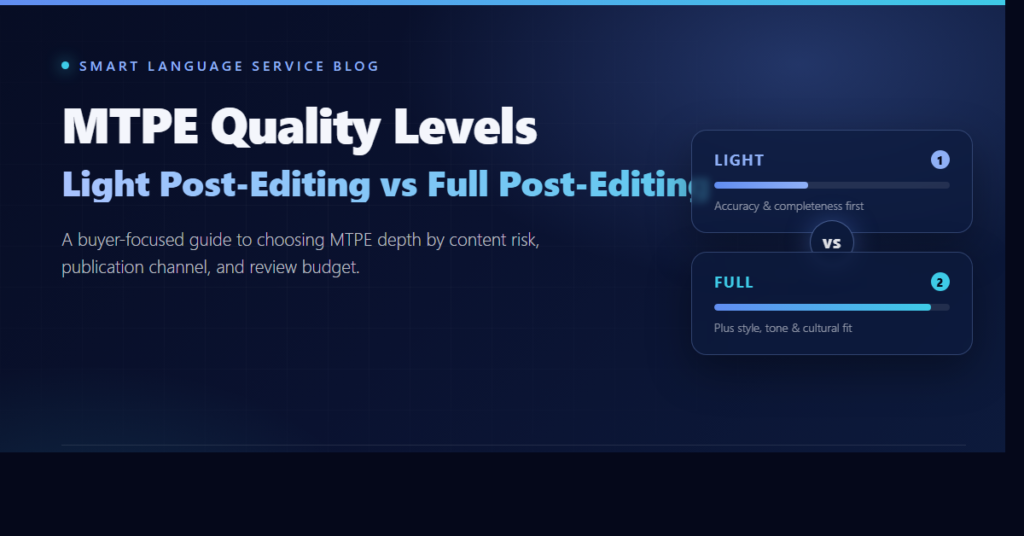
What MTPE quality levels really mean
Machine translation post-editing, or MTPE, is often described as one service, but in practice it covers a wide range of quality levels. A vendor may call a job 'post-editing' and deliver anything from a light cleanup of obvious machine errors to a rewrite that is indistinguishable from professional human translation. Buyers who treat MTPE as a single checkbox often discover the gap too late: the delivered text does not match the channel where it will be published, the review budget was spent in the wrong place, or the 'cheap' option turns out to require expensive rework.
MTPE quality levels exist precisely because machine translation output is not uniform. Modern MT engines produce fluent text that can be almost ready for low-risk use, and they also produce subtle errors that only a professional can catch: wrong terminology, dropped negation, incorrect numbers, missing cultural context, and awkward phrasing that a native reader immediately recognizes as translated. Defining the quality level at the start of a project is therefore a risk-management decision, not just a budget decision.
This article is written for localization buyers who need a practical framework for choosing between light post-editing and full post-editing. It covers what each level includes, when each level is appropriate, how to specify the requirement so vendors can price it accurately, and how to verify that the delivered work actually matches the level you paid for.
Why MTPE is not a single service with one price
The single biggest mistake in MTPE procurement is assuming that one price point covers all content. Post-editing effort varies with language pair, domain complexity, MT engine quality, text type, and the target quality level. A marketing headline, a user manual, a legal notice, and a training transcript have very different risk profiles. The same engine may produce excellent results for a technical FAQ and poor results for a creative brand page.
Light post-editing and full post-editing are the two most common levels, but even these have internal variation. Some light post-editing jobs correct only errors that change meaning; others also fix punctuation and obvious grammar. Some full post-editing jobs stop at terminology accuracy and style consistency; others include cultural adaptation, tone alignment, and channel-specific formatting. Buyers should define the level by what must be true about the final text, not only by a label.
A useful way to think about MTPE levels is through quality dimensions. The most important dimensions for business content are accuracy, completeness, terminology, style, tone, and cultural fit. Light post-editing focuses on the first two. Full post-editing addresses all six. The level you choose determines how much human effort is applied and, as a result, how much the project costs.
Light post-editing: the minimum viable quality
Light post-editing is designed for content where the main risk is factual or functional error, and where perfect style is not required. The goal is to make the machine output correct, complete, and understandable without polishing every sentence. Editors correct mistranslations, wrong numbers, dropped negation, incorrect names and dates, and obvious grammatical problems. They typically do not rewrite natural phrasing, adjust tone, or optimize text for a specific audience.
This level is a good fit for internal documents, draft content, large volumes of repetitive technical text, knowledge base entries, and content that will be reviewed by a subject-matter expert before publication. It is also appropriate when the content has a short lifecycle, such as internal announcements, temporary campaign copy, or data meant to feed a downstream process rather than a public audience.
The standard for light post-editing is often described as 'understandable and accurate, but clearly not human translation quality.' That is acceptable for many use cases, and it is much cheaper than full post-editing. The danger is using light post-editing for content that is customer-facing, legally sensitive, or brand-critical. In those cases, the savings are small compared with the cost of an error that reaches a customer.
For example, a product knowledge base that is already structured with screenshots may only need light post-editing: the user reads the steps, and the screenshots carry much of the meaning. A translated headline on the company homepage is a different case. If it sounds awkward or carries a slightly wrong implication, visitors notice immediately, and the brand pays a price that no cost-per-word saving can justify.
Full post-editing: quality close to human translation
Full post-editing produces text that meets professional human translation standards. The editor ensures accuracy and completeness, and also reviews terminology against the approved glossary, aligns the style with the source text and the brand voice, adapts tone and register to the target market, and checks that the text reads naturally for a native audience. In practice, full post-editing is close to editing and polishing a human translation.
Full post-editing is the right choice for customer-facing content, marketing material, legal and compliance text, training content, technical documentation that customers rely on, and any text where errors carry reputational or operational risk. It is also the default for content that will be published permanently, indexed by search engines, or used as a reference by non-technical readers.
The effort required for full post-editing depends on the source text and the MT output. Creative content, humor, metaphors, and culturally specific references demand more intervention than straightforward technical prose. That is why full post-editing prices vary more than light post-editing prices: the human editor is doing more than checking the machine output; they are making judgment calls about meaning, style, and market fit.
Buyers should also understand that full post-editing does not mean 'ignore the machine translation.' A good post-editor uses the MT output as a draft and improves it efficiently. When the source is well written and the engine is strong, the result can approach the cost of translation with light review. When the source is complex or the domain is specialized, full post-editing can cost nearly as much as human translation, because the editor's time is the dominant cost.
Where the two levels differ: accuracy, style, terminology, and cultural fit
To choose between light and full post-editing, it helps to separate the quality dimensions that each level covers.
Accuracy and completeness come first at both levels. Every post-editor must ensure that the text says what the source says, that numbers and names are correct, and that nothing is missing. Errors here can create real business damage: a wrong safety warning, an incorrect price, a misunderstood instruction, or a legal clause that says the opposite of what was intended.
Terminology is where many MTPE projects start to diverge. Light post-editing typically applies glossary checks only when the error is obvious. Full post-editing applies the glossary consistently across the document, including compound terms, product names, and internal naming conventions. If terminology consistency matters for your product, your documentation, or your search rankings, full post-editing is the safer level.
Style and tone are the clearest differentiators. Light post-editing leaves the machine's phrasing mostly intact as long as it is accurate. Full post-editing rewrites sentences that are awkward, overly long, or unnatural for the target audience. For marketing and customer-facing content, tone is not a cosmetic detail; it determines whether the text sounds like a global brand or like a translation artifact.
Cultural fit goes a step further. Full post-editing can adapt examples, units, formats, and references so they make sense in the target market. This is close to light localization work and is rarely part of light post-editing. If your content contains humor, metaphors, idioms, or market-specific examples, plan for a level that includes cultural judgment, and confirm with the vendor what is and is not in scope.
How content risk and publication channel should drive the choice
A practical way to choose MTPE depth is to score content by risk and visibility. Ask two questions: what happens if this text contains an error, and how visible is this text to the audience that matters?
Content with high error cost and high visibility needs full post-editing. Examples include pricing pages, safety instructions, legal documents, regulatory communications, public API documentation, patient-facing health content, and any text that journalists, customers, or regulators might quote. Content with low error cost and low visibility can use light post-editing: internal wikis, draft workflows, testing content, and large volumes of reference material that experts will review.
Publication channel matters because different channels have different tolerance for imperfect text. A search-indexed website page becomes part of the brand and competes on trust; awkward phrasing can reduce conversions and increase bounce rates. A training transcript read by employees may tolerate lighter editing if the goal is comprehension rather than publication. An email campaign is temporary, but it still reaches customers directly, so tone and style matter more than the content's lifecycle suggests.
The same logic applies to language pairs and engine behavior. If the MT output for a language pair is consistently weak, even 'light' post-editing requires more intervention. If the source content is full of ambiguity, colloquialisms, or cross-references, the effective effort for both levels increases. Buyers should not fix a single price per word for all languages without checking how the workload differs by market.
How to specify MTPE levels in an RFQ or statement of work
The most expensive MTPE project is the one where buyer and vendor have different expectations. To avoid that, specify the quality level in measurable terms before the project starts.
Define the minimum acceptable outcomes for each dimension. For accuracy, state that no meaning may change and that numbers, names, and units must match the source. For completeness, state that no segment may be skipped or truncated. For terminology, reference the approved glossary and require consistent use. For style, state whether the text must read naturally for a native audience and whether a specific brand voice applies. For cultural fit, list any examples, units, or references that must be adapted.
Describe the source content honestly. Vendors price MTPE based on effort, and effort depends on the source text as much as on the target level. If the source is poorly written, ambiguous, or full of inconsistencies, say so in the RFQ. The alternative is a quote based on assumptions that fail during production, followed by change orders and delays.
Ask the vendor how they will measure the level. A good vendor can describe their editing brief, their reviewer calibration, and their QA sampling for each level. If a vendor cannot explain the difference between their light and full post-editing offerings, that is a red flag. You should also agree on sampling criteria in advance: how many segments will be checked, which segments (high-risk ones first), and what happens when the sample fails.
What changes the cost and timeline of each level
Light post-editing is typically cheaper and faster than full post-editing because the editor does less per segment. But the difference is not a fixed percentage; it depends on the MT engine, language pair, domain, and source quality. In some projects, light post-editing is barely cheaper than full post-editing because the machine output is poor and requires extensive correction anyway.
Full post-editing costs more per word because the editor applies terminology, style, tone, and cultural judgment. The gap between levels is often wider for creative and marketing content than for technical content, because creative text needs more human judgment. For specialized domains, the availability of qualified editors also affects price; an editor who can handle legal or medical text is rarer than a generalist.
Timeline follows the same pattern. Light post-editing can be delivered quickly for large volumes, which is why it works well for internal content with fast turnarounds. Full post-editing requires more review time per segment, especially when the source is complex. If the project has a hard deadline, discuss it during scoping: the level, the volume, and the deadline must be planned together, not negotiated after production starts.
The practical takeaway for buyers is to compare quotes on the same specification. A low quote may simply mean light quality dressed up as full post-editing, or a quote may exclude glossary application, cultural adaptation, or final QA. Ask for the editing brief and the QA plan, and price the project on outcomes rather than on a label.
How to QA the MTPE level you actually ordered
Verification is where MTPE projects usually fail silently. A delivered file can pass a casual glance and still miss the agreed level. Plan QA the same way you plan production.
First, check the high-risk segments first. Numbers, product names, legal language, warnings, and customer-facing headlines carry the most risk, and they are also where post-editors are most likely to be conservative or inconsistent. Sample these segments explicitly instead of relying on a random draw.
Second, compare the delivered text against the agreed dimensions. If you ordered full post-editing, check that style and terminology are consistent across the whole document, not just that the text is accurate. If you ordered light post-editing, check that it is actually light: paying full post-editing prices for light quality is a different problem than the reverse, and it is easier to spot.
Third, use reviewers who understand the target market. Native reviewers can catch phrasing that is technically correct but unnatural, which automated checks and non-native reviewers will miss. For terminology-heavy projects, include a domain expert in the review loop.
Finally, build a short feedback loop with the vendor. Post-editing quality improves when the editing brief is adjusted after the first batches. If the sample reveals systematic issues, fix the brief before scaling, and re-sample until the failure rate is acceptable.
A practical checklist for choosing MTPE depth
- What happens if this text contains an error? If the answer includes legal, safety, financial, or reputational damage, choose full post-editing.
- Who will see this text? Public, customer-facing, and permanently published content needs full post-editing; internal and temporary content may not.
- Does the text depend on tone, style, or cultural references? If yes, full post-editing, and confirm cultural adaptation is in scope.
- Does terminology consistency matter? If your product names and terms must be identical across markets, full post-editing with glossary checks.
- How will you verify the delivered quality? Define sampling criteria and high-risk segments before production starts.
- How are you comparing vendor quotes? Require the same specification and the same QA plan from every vendor.
For a broader view of how MTPE fits into translation workflows, our earlier guide on translation vs MTPE compares the two workflows by content risk, volume, and quality expectations. If you are estimating a project, technical translation cost drivers explains what changes the final quote, and our guide on technical manual translation covers documentation quality requirements in more depth.
How Smart Language Service supports MTPE projects
Smart Language Service provides MTPE with clearly defined quality levels, documented editing briefs, and QA sampling tied to the agreed specification. For localization buyers who need light post-editing, we scope the work around accuracy and completeness so the price matches the actual risk. For buyers who need full post-editing, we apply terminology, style, tone, and cultural checks across the full document, with native reviewers and domain-aware QA.
We also help buyers choose the right level before production starts. Our scoping process covers source quality, language pairs, publication channels, glossary requirements, and review workflows, so the final quote reflects the work required rather than a generic label. Whether you are preparing a large technical documentation project or a customer-facing marketing campaign, the goal is the same: the delivered text matches the quality level you approved, at a price that reflects the real effort.