The Language Gap in AI
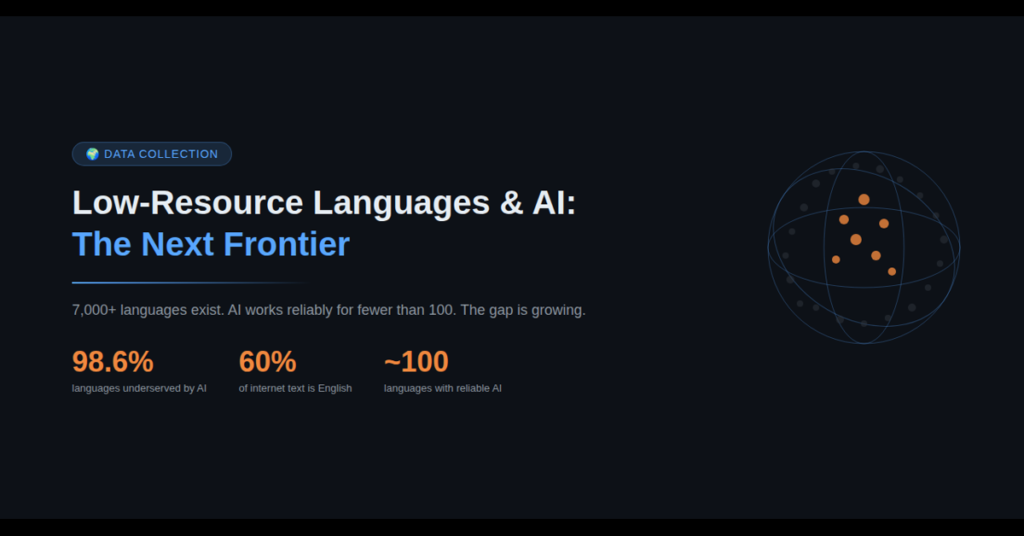
English makes up about 60% of all text on the internet. Mandarin Chinese, the world's second most spoken language by native speakers, accounts for roughly 5%. Swahili — spoken by over 100 million people across East Africa — barely registers.
This imbalance shows up every time someone tries to use a voice assistant in Amharic, ask a chatbot a question in Quechua, or run sentiment analysis on Yoruba social media posts. The model doesn't fail because the algorithm is bad. It fails because the training data simply doesn't exist at scale.
As of 2026, major language models perform reliably on roughly 100 languages out of the 7,000+ spoken worldwide. That means 98.6% of the world's languages are underserved by AI. For companies building products for emerging markets, this isn't an academic problem — it's a competitive blind spot.
Why Data Scarcity Persists
Collecting high-quality training data for low-resource languages faces three compounding challenges:
Digitized content is scarce. Many languages have rich oral traditions but limited written corpora online. You can scrape billions of English sentences from the web in an afternoon. For Tigrinya or K'iche', you might find a few thousand documents — and many are poorly formatted or machine-translated from other languages, making them unsuitable for training.
Annotation expertise is hard to source. Even when you find raw data, you need native speakers who understand both the language and the annotation task. A linguist who can label parts of speech in French is not automatically qualified to do the same for Bambara. Finding and vetting annotators for underrepresented languages requires local networks, not just crowdsourcing platforms.
Dialects multiply the problem. "Arabic" is not one language for AI purposes. Moroccan Darija, Egyptian Arabic, and Gulf Arabic are mutually unintelligible in practice. A model trained on Modern Standard Arabic will struggle to understand a customer service call in Tunisian dialect. Each dialect needs its own data pipeline — and most have almost none.
The Business Cost of Ignoring Low-Resource Languages
Companies that treat language support as an afterthought face measurable losses:
When a major ride-hailing app launched in Nairobi, its English-only voice interface forced drivers to type commands while driving — a safety issue that contributed to a 23% higher cancellation rate compared to markets with voice support in local languages. The company later invested in Swahili speech data collection and saw driver retention improve by 18%.
In healthcare, diagnostic chatbots trained only on English medical literature miss cultural context in symptom descriptions. A study by the African Institute for Mathematical Sciences found that symptom descriptions in Hausa and Igbo often use metaphorical expressions that direct translation misses entirely, leading to inaccurate preliminary diagnoses.
For customer service automation, the gap is equally costly. Zendesk's 2026 customer experience trends report found that 67% of consumers in Southeast Asia and Sub-Saharan Africa prefer support in their local language — but fewer than 30% of enterprise support platforms offer reliable automation in those languages.
What Most Teams Get Wrong
The most common mistake we see is assuming that multilingual support means translating your English dataset. Translation preserves words, not speech patterns, cultural references, or the natural way people express themselves in their native language. A model trained on translated English data will sound grammatically correct but culturally foreign.
Another frequent error is prioritizing high-resource languages first and treating low-resource languages as "phase two." By the time phase two arrives, the product's architecture has already assumed English-like data distributions — and retrofitting support for languages with different scripts, grammar structures, or phonetic systems requires fundamental changes, not just more data.
Some teams attempt to solve the problem with synthetic data generation — using LLMs to create training examples in target languages. This works for grammar exercises but fails for anything that requires authentic human expression: sentiment analysis, conversational AI, and speech recognition all degrade significantly when trained on synthetic data alone.
Building a Multilingual Data Strategy
Companies that get multilingual AI right follow a different playbook:
Start with the markets you actually serve. If your product is launching in Vietnam, invest in Vietnamese speech and text data before expanding to Spanish. Market-first prioritization beats alphabetical or population-size ordering every time.
Collect native data, not translated data. Every sentence, every audio sample should originate from a native speaker in a natural context. This means working with local communities, not translation vendors.
Plan for dialects from day one. Budget for dialect diversity as a core requirement, not an edge case. The cost of collecting dialect-specific data upfront is far lower than the cost of retraining a model that fails in production.
Partner with vendors who have local networks. The hardest part of low-resource data collection isn't the technology — it's finding and managing native speakers across geographies. A vendor with established annotator networks in your target languages will deliver better data faster than any tool-based workaround.
The companies that win in global AI won't be the ones with the biggest models. They'll be the ones with the most representative data. And that starts with investing in the languages everyone else is ignoring.
Key Takeaways
- 98.6% of the world's 7,000+ languages lack sufficient AI training data
- Translated data ≠ native data — models trained on translations lose cultural nuance
- Dialect diversity requires separate data pipelines, not one-size-fits-all approaches
- Market-first language prioritization outperforms population-size or alphabetical ordering
Contact Smart Language Service for multilingual data collection tailored to your target markets →