The Short Version: Scale Breaks Everything Until It Doesn't
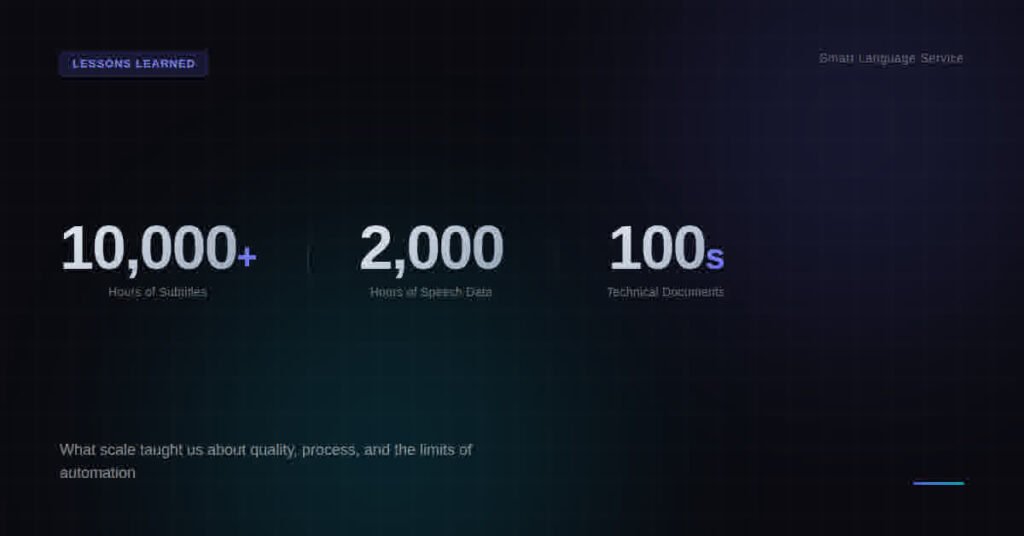
Five years ago, Smart Language Service was a small team handling a handful of translation projects each quarter. Today, we've delivered over 10,000 hours of subtitle localization for Pixelogic, collected and annotated 2,000 hours of Moroccan Arabic speech data for AI training, and translated hundreds of technical documents ranging from 20-page API guides to 300-page industrial equipment manuals.
Getting here was not a smooth upward line. We made expensive mistakes. We shipped work we weren't proud of. We rebuilt internal processes three times before finding systems that actually held up under real production pressure.
This article is an honest accounting of what we learned along the way. If you're managing language operations at scale, or evaluating a vendor for a large project, some of this might save you a few bad weeks.
Lesson 1: Your First QC Process Will Be Wrong
When we started the Pixelogic subtitle project, our quality control was straightforward: a second linguist reviews the first linguist's work, sign off, deliver. That worked fine for 50 hours of content per week.
At 200 hours per week, it collapsed. Reviewers developed fatigue patterns. They caught terminology errors but missed timing issues. Subtitles that read fine in isolation became inconsistent across episodes of the same series.
We switched to a sampling-based QC model with spot checks weighted toward known problem areas: proper nouns, idiomatic expressions, and timing boundaries. Reviewers now focus their attention where errors actually cluster instead of trying to catch everything with equal effort. Our error rate dropped 40% after the switch, and reviewer burnout dropped even more.
The takeaway: if your QC process was designed for small batches, it will fail at scale in ways you won't notice until a client points them out.
Lesson 2: Speakers Are Not Interchangeable
The Moroccan Arabic speech data project taught us something we should have known already. When you need 2,000 hours of natural-sounding speech from a specific dialect, you can't just hire people who speak Arabic and hope for the best.
Early in the project, we recorded speakers who were technically fluent in Darija but had spent most of their adult lives in France or the Netherlands. Their speech patterns were recognizably Moroccan Arabic, but the code-switching frequency and phonetic drift didn't match what the AI models needed. The data was usable, but only after the client's ML team flagged the distribution mismatch and we re-recorded about 180 hours with speakers currently living in Morocco.
We now screen speakers with a 10-minute conversational sample before onboarding them for long recording sessions. It costs us an extra day per batch of new speakers. It saves us weeks of rework.
Lesson 3: Technical Manuals Need Engineers, Not Just Translators
A 300-page technical manual for industrial CNC equipment taught us this lesson the hard way. We assigned it to our best technical translator, someone with a strong track record in software documentation.
The translation was linguistically clean. It was also wrong in places that only a mechanical engineer would catch. Torque specifications were translated correctly but the contextual notes about load-bearing tolerances used imprecise phrasing that could lead to misinterpretation on a factory floor.
Since that project, we pair subject-matter reviewers with our translators on any document where a translation error could cause physical harm or equipment damage. The reviewer doesn't need to be bilingual. They need to read the target language well enough to flag when something sounds technically off. That single addition to our workflow has made our technical translations measurably more reliable.
Lesson 4: Client Feedback Loops Beat Internal Benchmarks
We spent a lot of energy building internal quality scores. Word error rates, timing accuracy metrics, inter-annotator agreement for data labeling. All useful. None of them predicted client satisfaction very well.
What actually moved client satisfaction was shortening the feedback loop. On the subtitle project, we started delivering in smaller batches with a 48-hour review window instead of monthly bulk deliveries. Clients caught issues early. We adjusted style guides in real time instead of discovering at month's end that we'd been producing 500 hours of content with a slightly wrong register.
Internal benchmarks tell you whether your team is consistent. Client feedback tells you whether consistency is pointed in the right direction. You need both, but the second one matters more for retention.
Lesson 5: Volume Discounts Should Never Mean Volume Shortcuts
There's a temptation in this industry to price large projects aggressively and then quietly reduce the attention per unit to protect margins. We've seen competitors do it. We've been tempted to do it ourselves.
Every time a vendor offers you 10,000 hours of localization at a price that seems too good, ask what their QC staffing ratio looks like at that volume. Ask how many hours of content a single reviewer handles per day. If the numbers don't add up, the quality won't either.
We've chosen to be transparent about this with our clients. When Pixelogic scaled up their volume with us, we showed them our staffing plan, our reviewer capacity, and where the cost savings came from (process automation, not reduced human oversight). That conversation built more trust than any discount could have.
Lesson 6: The Hardest Language Pair Is the One Nobody Talks About
Everyone in this industry has opinions about Japanese-to-English or Arabic-to-French. Those pairs get attention, research, tooling support. What catches you off guard are the pairs where resources are thin and expectations are high.
Moroccan Arabic to English transcription and annotation was one of those. Darija doesn't have standardized orthography. Two annotators might transcribe the same spoken word differently and both be defensible. Building consistent annotation guidelines required us to create an internal reference dictionary of over 4,000 entries with example audio clips, just to keep inter-annotator agreement above 90%.
If your project involves a language variety that doesn't appear in mainstream NLP benchmarks, budget an extra 15-20% for guideline development and calibration. You'll spend it regardless. The question is whether you plan for it or absorb it as overrun.
What We Know Now
After all these projects, four things are clear:
- Process design matters more than individual talent. Great linguists in a bad workflow produce mediocre output. Average linguists in a well-designed system produce reliable, consistent work.
- Specialization compounds. The teams that worked on the Moroccan Arabic project got noticeably better after 500 hours. By 1,500 hours, they were catching issues the client's own reviewers missed.
- Transparency with clients is a competitive advantage. Sharing your real capacity, your actual error rates, and your process limitations builds the kind of trust that leads to multi-year contracts.
- Every large project has a calibration period. The first 5-10% of any high-volume delivery is essentially a paid learning phase. Plan for it, communicate about it, and use it to lock in the processes that carry the remaining 90%.
Let's Talk About Your Next Project
If you're planning a large-scale subtitle localization, speech data collection, or technical translation project, we'd like to hear about it. We'll give you an honest assessment of what's involved, including the parts that usually get glossed over in sales conversations.
Reach out to our team at Smart Language Service. We'll set up a call, walk through your requirements, and tell you exactly what we'd do differently based on what we've learned from the last 10,000 hours.