
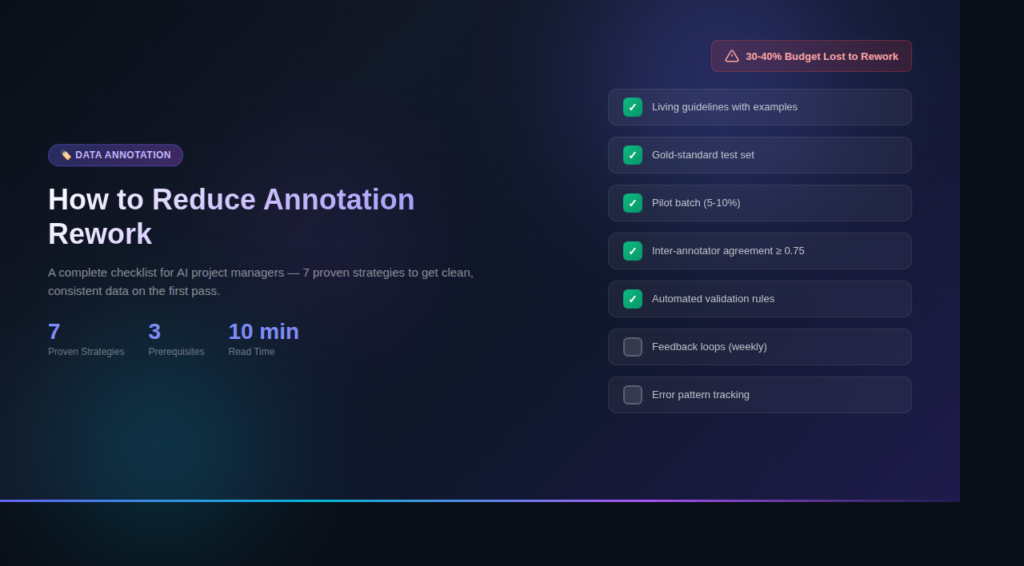
The Hidden Cost of Annotation Rework
You've spent weeks planning your data annotation project. Guidelines are written, annotators are hired, and the first batch of labels is coming in. Then your ML engineer reviews the data — and finds that 35% of it doesn't meet the quality bar. The entire batch needs to be re-annotated. Your timeline just doubled.
This isn't a rare horror story. In our experience managing hundreds of annotation projects, rework typically consumes 30-40% of the total annotation budget when teams skip proper quality controls upfront.
For a $50,000 project, that's $15,000-20,000 wasted on data that had to be done twice. For a 6-week timeline, it means your model training slips by another month.
Before You Start: 3 Prerequisites
Don't let annotators touch real data until these three things are in place:
1. A Living Annotation Guideline
Your guideline document shouldn't be a static PDF. It needs to be a living reference that evolves as edge cases emerge. Include:
- Clear definitions for every label category with concrete examples
- Edge case decision trees — "If X and Y, label as A; if X but not Y, label as B"
- Visual examples of correct vs. incorrect annotations for each category
- A changelog that tracks every rule update and communicates it to all annotators
2. A Gold-Standard Test Set
Before the main project begins, have every annotator label a small set (50-100 items) that you've already annotated yourself. This serves two purposes:
- Baseline qualification — annotators who score below 85% agreement need additional training
- Guideline validation — if qualified annotators consistently disagree on specific items, your guideline has an ambiguity that needs fixing
3. A Realistic Timeline with Buffer
Plan for 20% more time than the raw annotation estimate. That buffer covers quality review cycles, guideline updates, and the inevitable edge cases that no one anticipated.
7 Steps to Minimize Rework
Step 1: Start With a Pilot Batch
Never annotate your entire dataset in one go. Start with a pilot of 5-10% of the data. Review every single item in the pilot before scaling up. Use the findings to update your guidelines, then restart the pilot if necessary. The cost of fixing a broken guideline on 200 items is tiny compared to fixing it on 20,000.
Step 2: Implement Inter-Annotator Agreement Checks
Have at least 10-20% of your data annotated by two independent annotators. Calculate Cohen's kappa or F1 agreement between them. If agreement drops below 0.75, your guidelines have ambiguities that need clarification before continuing.
Step 3: Build a Feedback Loop Between Annotators and ML Engineers
The biggest source of rework is a disconnect between what annotators think they're labeling and what the ML model actually needs. Set up weekly syncs where:
- ML engineers show annotators how the model is performing on annotated data
- Annotators flag confusing edge cases they've encountered
- Guidelines are updated collaboratively based on both perspectives
Step 4: Use Automated Validation Rules
Before human reviewers see the data, run automated checks to catch the most common errors:
- Mandatory fields — no label can be submitted without all required attributes
- Range checks — numeric annotations fall within expected bounds
- Consistency rules — e.g., if label is "vehicle," subcategory cannot be empty
- Outlier detection — flag annotations that differ significantly from the batch average
Step 5: Tiered Review Process
Don't rely on a single reviewer. Use a three-tier system:
- Automated checks (catches ~40% of errors instantly)
- Peer review — another annotator reviews a random 20% sample
- Expert review — a senior annotator or ML engineer reviews flagged items and edge cases
Step 6: Track Error Patterns, Not Just Error Rates
Knowing that "5% of annotations are wrong" is less useful than knowing "60% of errors come from 2 annotators who misunderstood the same guideline." Track errors by:
- Annotator — identifies who needs retraining
- Label category — identifies which guidelines need clarification
- Error type — systematic (misunderstanding) vs. random (carelessness)
Step 7: Document Everything
Every guideline change, every edge case decision, every annotator question — document it. When your project scales from 5 to 50 annotators, this documentation becomes the single source of truth that prevents inconsistency.
3 Common Mistakes That Guarantee Rework
Mistake 1: "We'll Fix the Guidelines Later"
Teams that defer guideline refinement until after the first major batch typically see 40-60% rework rates. The fix is simple: never annotate more than 10% of your dataset before validating the guidelines.
Mistake 2: Hiring for Speed Over Accuracy
An annotator who works 2x faster but has a 20% error rate costs more than one who works at a normal pace with a 5% error rate — because the faster annotator's errors take longer to find and fix than the annotations themselves.
Mistake 3: No Feedback from the ML Team
When annotators work in isolation from the downstream ML team, they optimize for what they think matters — not what the model actually needs. The result: perfectly consistent annotations of the wrong things.
Summary: Your Anti-Rework Checklist
- ✅ Living guidelines with examples, edge cases, and a changelog — not a static document
- ✅ Gold-standard test set to qualify annotators and validate guidelines before scale-up
- ✅ Pilot batch (5-10%) reviewed item-by-item before full production
- ✅ Inter-annotator agreement measured regularly; below 0.75 = pause and clarify
- ✅ Automated validation catches ~40% of errors before human review
- ✅ Feedback loops between annotators and ML engineers, updated weekly
- ✅ Error tracking by annotator, category, and type — not just overall rate
Need Help Getting It Right the First Time?
At Smart Language Service, we've built these quality controls into every annotation project we deliver. Our three-layer review process catches issues before they become rework — saving our clients time, budget, and frustration.