
Why Is Data Annotation Pricing So Hard to Pin Down?
If you have asked three annotation vendors for a quote and got three wildly different numbers, you are not alone. A computer vision team we worked with received quotes ranging from $0.03 to $0.85 per image for the same bounding-box task. The difference was not markup — it was scope.
Data annotation is not a commodity. The price depends on what you are labeling, how accurate it needs to be, who is doing the labeling, and what happens when the labels are wrong. This guide breaks down each factor so you can estimate your budget before you sign anything.
How Annotation Vendors Price Their Work
Most vendors use one of three pricing models. Knowing which one you are being quoted under matters — it determines whether your cost goes up or down as your project scales.
Per-Label Pricing
You pay for each individual label: one bounding box, one named entity, one sentiment tag. This is the most common model and the easiest to compare across vendors. But it can hide costs — a single image with 47 objects costs 47 times more than an image with one object, even if the labeling complexity is the same.
Per-Hour Pricing
You pay for annotator time, regardless of output volume. This works well for tasks that are hard to count — like writing free-form descriptions or adjudicating disagreements between annotators. The risk is that slower annotators cost you more. A good vendor tracks velocity metrics and guarantees throughput.
Per-Project (Fixed Price)
A single quote for the entire dataset. This gives you budget certainty but requires the vendor to understand your scope perfectly. If your guidelines change mid-project, expect change orders. We recommend fixed-price only when your annotation guidelines are frozen and your data is representative of the full set.
Pricing Benchmarks by Annotation Type (2026)
These ranges reflect market rates we see across our own projects and industry reports. They are starting points — your actual price may be higher or lower depending on the factors in the next section.
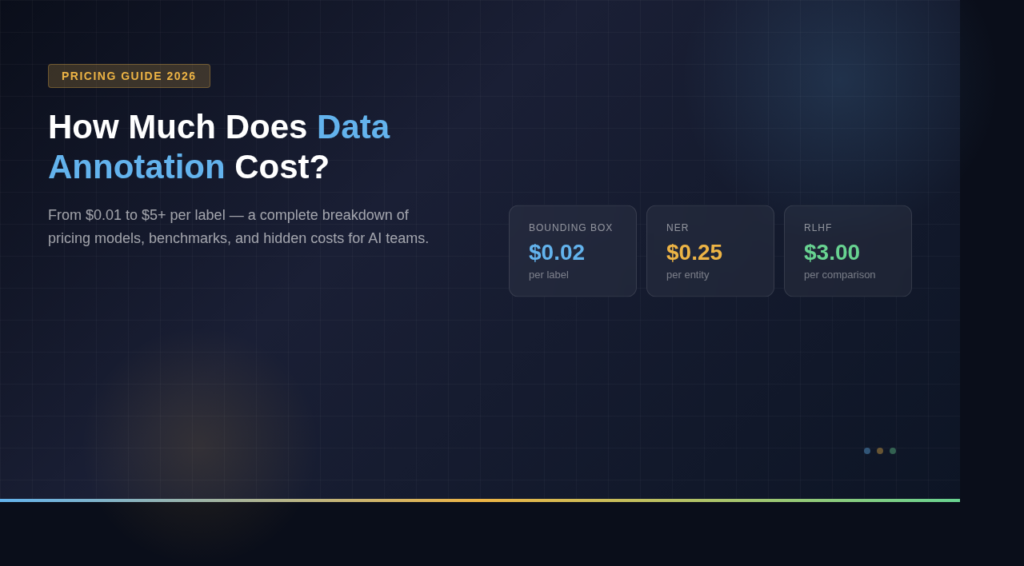
| Annotation Type | Per-Unit Price Range | Typical Unit |
|---|---|---|
| Image Bounding Box | $0.02 – $0.15 | per box |
| Image Polygon Segmentation | $0.10 – $0.80 | per object |
| Image Classification | $0.01 – $0.05 | per image |
| Named Entity Recognition (NER) | $0.03 – $0.25 | per entity |
| Text Classification / Sentiment | $0.02 – $0.10 | per document |
| Speech Transcription | $0.50 – $2.00 | per audio minute |
| Speech Time-Alignment | $0.80 – $3.00 | per audio minute |
| RLHF Preference Ranking | $0.50 – $3.00 | per comparison |
| Video Tracking (frame-by-frame) | $0.05 – $0.30 | per frame |
| 3D Point Cloud Annotation | $0.50 – $5.00 | per object |
RLHF (Reinforcement Learning from Human Feedback) is the fastest-growing segment. As LLM teams scale up preference-tuning datasets, demand for qualified human raters has pushed prices up roughly 40% year-over-year.
What Drives the Price Up — or Down
1. Domain Complexity
Labeling everyday objects — cars, people, furniture — is cheap. Labeling tumors on MRI scans requires annotators who understand medical imaging. Those annotators cost more, and they are harder to find. A radiologist-reviewed medical dataset can cost 5 to 10 times more than a standard object-detection set.
2. Accuracy Requirements
A 95% accuracy target is standard. Push it to 99% and your cost roughly doubles, because you need multiple annotators per item plus an adjudication layer. We had a client who wanted 99.5% accuracy for a legal NER task — the cost was three times the original quote because every disputed label required a lawyer to review.
3. Language and Rarity
English annotators are abundant. Finding qualified annotators for Tibetan, Somali, or Luxembourgish is not. For low-resource languages, expect to pay a 3x to 8x premium. We ran a Moroccan Arabic project where speaker recruitment alone cost more than the actual annotation.
4. Tooling and Platform
Some vendors include their annotation platform in the price. Others require you to provide access to your own (Labelbox, Scale AI, custom). Platform costs can add $0.005 to $0.02 per label on top of labor — it is easy to miss this if you are only comparing per-label rates.
5. Volume and Commitment
10,000 labels gets you a different price than 1,000,000. Vendors offer volume discounts because onboarding and training annotators is the most expensive part — once they are trained, marginal cost drops significantly. A committed multi-month engagement typically gets you 20-35% off the per-unit rate.
6. Rework Risk
The single biggest hidden cost in annotation is rework. If your guidelines are vague and the first batch comes back wrong, you pay twice: once for the bad labels, and again for the corrected ones. We estimate that unclear guidelines add 30-50% to total project cost through rework cycles.
What a Professional Quote Should Include
When you receive a quote, check for these items. If any are missing, ask for clarification before signing:
- Unit definition: What exactly is being counted? One image? One object within an image? One sentence?
- Accuracy target: What accuracy percentage is guaranteed, and how is it measured?
- Revision policy: How many rounds of revision are included? What triggers a revision?
- Platform costs: Is the annotation tool included or billed separately?
- Timeline: How many labels per day/week? When is the full delivery?
- Data security: Where is the data processed? Is there an NDA? Can annotators download data?
- Sample batch: Will the vendor annotate a free or low-cost pilot batch (50-100 items) before the full project?
How to Get an Accurate Quote
Before you reach out to vendors, prepare these materials. Vendors who receive complete briefs give accurate quotes. Vendors who receive vague briefs give low quotes that balloon later.
- Sample data: Provide 50-100 representative examples. Not the easiest ones — the typical ones, including edge cases.
- Annotation guidelines: A document that defines every label, includes examples, and specifies what to do when an item is ambiguous.
- Volume estimate: Even a rough range (50,000-100,000 items) helps vendors price accurately.
- Accuracy requirements: State your target accuracy and how you plan to measure it (gold standard subset, inter-annotator agreement, etc.).
- Timeline: When do you need the data? Rush projects cost 25-50% more.
- Domain context: Explain what the data will be used for. A vendor who understands your end goal can suggest better annotation strategies.
Summary: Key Takeaways
- Annotation pricing ranges from $0.01 to $5+ per label depending on type and complexity.
- Accuracy requirements are the biggest cost multiplier — 99% accuracy costs roughly 2x more than 95%.
- Rework from vague guidelines adds 30-50% to total project cost. Invest time in your brief upfront.
- Always request a pilot batch before committing to a full project — it reveals whether the vendor understands your needs.
Tell us about your annotation project — we respond within 24 hours with a detailed quote.