OpenAI's $730B Valuation: AI Enters a Capital Supercycle
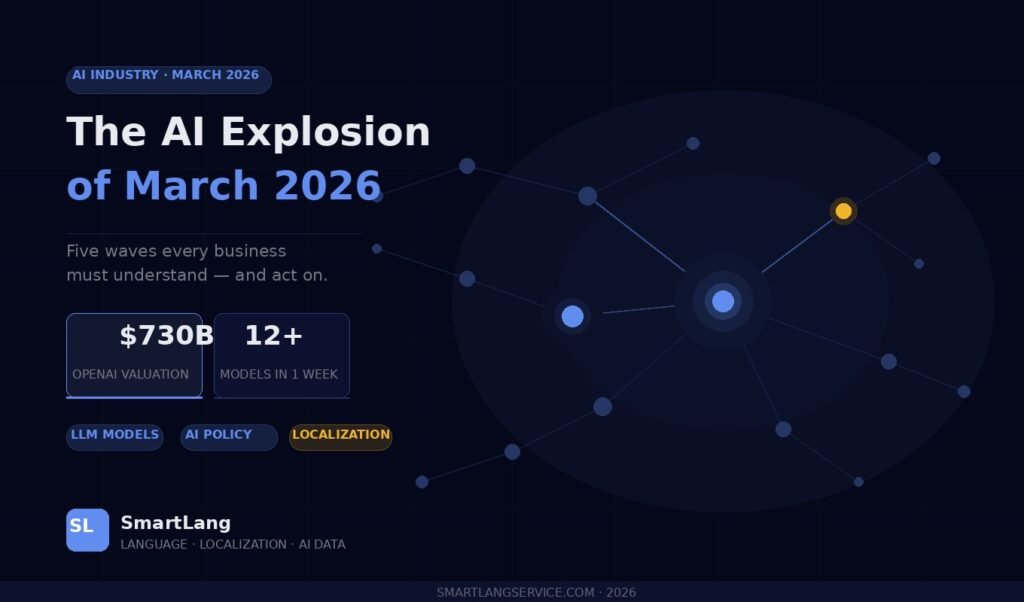
March 2026 saw OpenAI close one of the largest private fundraising rounds in technology history — $110 billion from Amazon, NVIDIA, and SoftBank, pushing its pre-money valuation to $730 billion. To put that in perspective: OpenAI is now valued above the majority of publicly listed companies worldwide.
At the same time, autonomous driving startup Wayve closed a $1.2 billion Series D, and global AI infrastructure investment continued its breakneck pace. Capital is betting — at scale — that AI will rewrite the rules of every industry. For businesses, the signal is clear: AI tools will keep getting cheaper and more powerful, and the window to adapt is narrowing fast.
12 Models in One Week: Open Source Is Closing the Gap
In the first week of March alone, the AI world witnessed something remarkable: 12+ major model releases across the US, China, and Europe in just seven days, spanning language, video generation, 3D spatial reasoning, and GPU kernel automation.
NVIDIA's Nemotron 3 Super stood out — a 120-billion-parameter Mixture-of-Experts model that scored 60.47% on SWE-Bench Verified, the highest open-weight score ever recorded, nearly 20 points above OpenAI's comparable open-source model. Meanwhile, Alibaba's Qwen 3.5 9B matched much larger closed models on the GPQA reasoning benchmark at roughly 1/13th the API price of Claude's flagship tier.
The takeaway: the open-source era has arrived. Small teams can now build world-class AI products at minimal cost. The benchmark wars have given way to a deployment reality: which models actually work in production?
Global AI Regulation: Compliance Is Now a Business Essential
In 2026, AI regulation moved from discussion to enforcement. The EU AI Act came into full effect in January, requiring all AI systems deployed in European markets to meet transparency, safety, and accountability standards — with fines up to 7% of global annual revenue for non-compliance.
In March, the US passed the AI Accountability Act, requiring companies using AI in high-stakes decisions — hiring, lending, healthcare, criminal justice — to conduct and publish regular bias audits. India extended its DPDP data protection law to cover AI systems processing personal data at scale.
The result: companies operating across borders now face a genuine patchwork of AI regulations. Being compliant in Europe doesn't mean being compliant in the US, and neither guarantees compliance in India. Each market has different legal language, terminology, and documentation requirements — and the demand for localized compliance documents is rising fast.
What 80,000 People Really Fear About AI
Anthropic published the largest AI user survey to date in March — 80,508 participants across the globe. The top desires: professional excellence and life improvements through AI. The core fears: AI unreliability and job displacement.
The report revealed a nuanced dual role: people experience AI as both a productivity amplifier and a potential dependency they're uncertain about. This tension defines how the general public — and employees — actually relate to AI in 2026.
On the misuse front, March saw multiple high-profile Deepfake incidents: hyper-realistic AI-generated images were used to spread political disinformation across social media at scale. AP News fact-checkers confirmed multiple batches of "visual evidence" were entirely fabricated, highlighting the urgent need for human-verified content and expert review — exactly where professional linguists remain irreplaceable.
AI and Jobs: Replacement or Reshaping? McKinsey's Latest Data
McKinsey's Global Institute March 2026 report found that 12% of all work tasks across the economy have been automated by AI over the past two years — while 8% of new job categories created in the same period were directly AI-related. Net employment impact is approximately flat, but structural disruption is already visible.
The hardest-hit functions: junior legal research, medical imaging reading, financial data analysis, content moderation, and first-tier customer service. Block announced layoffs of over 4,000 employees (roughly 40% of its workforce) in March, explicitly citing AI tools enabling smaller teams to do what large teams once required. Atlassian redirected $236 million freed up from layoffs directly into AI development.
The pattern is clear: the competitive advantage in the AI era belongs to companies that integrate AI into their workflows fastest — not those that simply have the most AI tools.
Action Guide: The Language Localization Opportunity in the AI Era
The AI explosion isn't just disruption — it's creating enormous opportunity. As AI products, compliance documents, and training data needs grow exponentially, language capability is becoming one of the scarcest infrastructure assets of the AI era.
Three specific demand categories are expanding rapidly:
① Multilingual AI training data collection — High-quality large models require diverse, multilingual corpora. Whether video annotation, audio transcription, or multilingual Q&A pairs, the value of professional data collection teams is being repriced upward.
② Global localization of AI products — AI applications are reaching global markets at unprecedented speed. UI strings, help documentation, and marketing content all require rapid multilingual adaptation.
③ AI regulatory compliance document translation — The EU AI Act, US AI Accountability Act, India's DPDP — each market's compliance requirements differ, and legal localization has become a non-negotiable for any company with cross-border ambitions.
SmartLang delivers end-to-end solutions across all three: large-scale AI data collection and annotation, professional translation and localization, and AI-assisted translation (MTPE). Whether you're a tech company training the next generation of AI models or an enterprise expanding globally, we're the language partner you need.