The Speed vs. Quality Myth
If you work in procurement, you've probably heard this before: "You can have it fast, or you can have it right — pick one."
We've been hearing that our entire careers in language services. And honestly? We never bought it.
When a gaming publisher needs 50,000 lines of UI text localized into 12 languages in three weeks, the answer isn't to hire more translators and hope for the best. The answer is process design. When an AI startup needs 500 hours of annotated speech data before their investor demo, you don't skip the quality checks — you build them into a tighter timeline.
Over the past few years, we've built a workflow that lets us handle genuinely urgent projects without the usual quality trade-off. This isn't theory. It's the system we used on 200+ projects across data collection, annotation, subtitle localization, and document translation. Some of those projects had deadlines that made our own project managers nervous. All of them shipped on time, and every single one passed our internal quality gates.
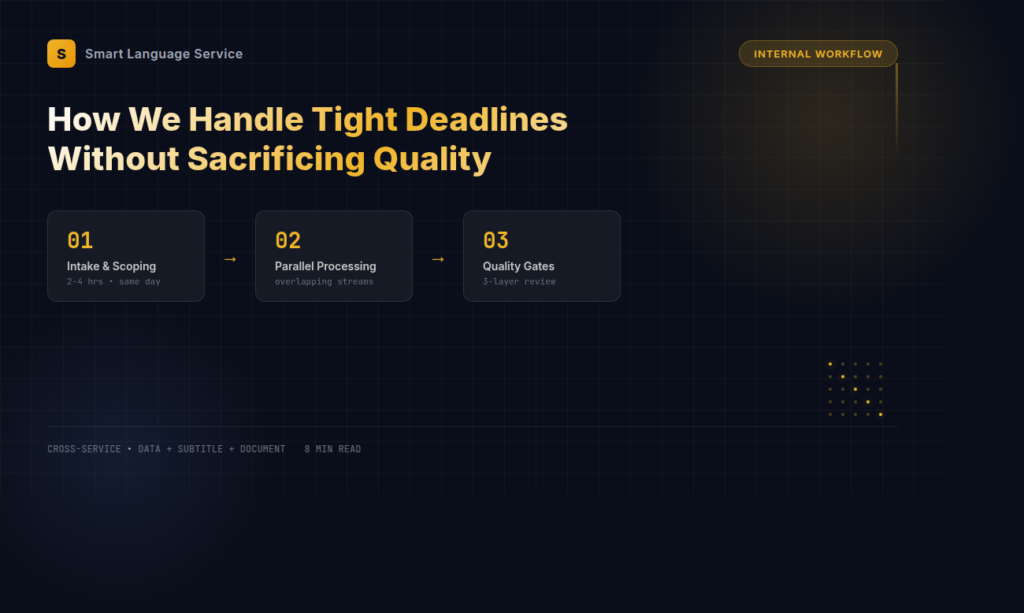
Our 3-Phase Workflow
Every project that comes through our doors — regardless of service type — follows the same three-phase structure. The difference between a "rush" project and a standard one isn't the process. It's how we compress the timeline within each phase.
Phase 1: Intake & Scoping (2–4 hours, same day)
This is where most agencies slow down. They send you a questionnaire, wait three days for your response, then schedule a kickoff call for next week. We do intake the same day the request comes in.
Our project manager reviews your materials, identifies the language pairs, estimates volume, and flags any technical requirements (file formats, CAT tool compatibility, domain-specific terminology) within two to four hours. If there are ambiguities, we don't email you a list of 20 questions — we hop on a quick call and resolve them live.
By end of day one, you have a confirmed scope, a team assignment, and a realistic delivery schedule. Not a vague promise. A real timeline.
Phase 2: Parallel Processing (the actual work)
This is where the real magic happens. Instead of a linear pipeline — where step 2 waits for step 1 to finish — we run overlapping workstreams.
For subtitle localization, this means our terminology glossary team works on episode 1's key terms while the translation team starts on episode 2. For data annotation, our QA reviewers begin spot-checking batch 1 while annotators are still working on batch 3. For document translation, the style guide and glossary are locked in before the first page is translated, so every translator is working from the same reference from day one.
The compression comes from eliminating idle time between phases, not from rushing the actual work.
Phase 3: Quality Gates (non-negotiable)
Here's the one thing we never compromise on, regardless of deadline: our three-layer review process.
Layer 1: Peer review. Every deliverable is checked by a second linguist who didn't work on the original. This catches terminology inconsistencies, tonal mismatches, and context errors that the original translator misses because they're too close to the work.
Layer 2: Domain specialist review. For medical content, a linguist with healthcare background reviews it. For legal documents, someone with legal experience. This isn't a nice-to-have — it's where the errors that cause real problems get caught.
Layer 3: Final QA pass. A senior project manager does a end-to-end quality check, verifying formatting, completeness, and delivery specifications.
On standard projects, these three layers might take 24–48 hours. On rush projects, we compress to 12–18 hours by having all three reviewers work in sequence on the same day. The depth doesn't change. The schedule does.
Real-World Test Cases
The 72-Hour Subtitle Localization Sprint
A streaming platform came to us with 12 episodes of a documentary series — 8 hours of content total — that needed to be localized from English into Simplified Chinese, Korean, and Japanese. They had a hard launch date in 72 hours. Missing it meant losing a licensing window worth six figures.
Here's what happened: Phase 1 wrapped in 3 hours. We assigned three native-language teams (one per target language), each with a lead translator and a peer reviewer. Phase 2 ran for 48 hours with overlapping shifts. Phase 3 compressed into a single 14-hour quality review window on day 3. All three language versions were delivered 4 hours before the launch deadline.
Zero post-delivery errors reported. The client renewed their contract the following quarter.
The Same-Week Data Annotation Emergency
An AI company needed 200 hours of speech data annotated with speaker demographics, acoustic features, and transcription-level accuracy. Their model training pipeline was blocked, and they had a demo with investors in five business days.
We assembled a team of 12 annotators working across two time zones. Phase 1 (scoping and guideline alignment) took 4 hours. Phase 2 ran over three days with real-time QA feedback loops — annotators got corrections within an hour, not at end-of-day review. Phase 3 involved a dedicated QA team of 3 specialists who reviewed the full dataset in parallel with the final annotation wave.
Delivered in 4 business days. The investor demo went ahead as planned.
What Could Go Wrong
We're not going to pretend this system is foolproof. Rush projects carry real risks, and we've learned from the ones that went sideways.
Scope creep is the #1 deadline killer
A "small addition" to the source file on day 2 of a 5-day project can derail the entire schedule. That's why we lock scope at the end of Phase 1 and require formal change requests for anything new. Clients sometimes push back on this, but it's the only way to protect the delivery date.
Reviewer fatigue is real
When you compress three quality layers into a single day, the people doing the reviewing need to be fresh. We rotate reviewers and enforce mandatory breaks. A tired reviewer misses errors — and that defeats the entire purpose of having quality gates in the first place.
Some things genuinely can't be rushed
Cultural adaptation takes time. A subtitle that's technically accurate but culturally tone-deaf will hurt the client more than a late delivery. We've had to tell clients "no" when the timeline wouldn't allow for proper cultural review — and most of them respected that, even if they didn't like hearing it.
Lessons Learned Over 10,000+ Hours
After delivering 10,000+ hours of subtitles, 2,000+ hours of speech data, and hundreds of technical documents, a few patterns have become very clear:
- The bottleneck is almost never the translators. It's the handoff between phases. Eliminate the idle time, and you compress the timeline without touching the quality.
- Glossaries are worth their weight in gold. Every rush project that went smoothly had a terminology guide locked in before work started. Every one that had issues didn't.
- Communication speed matches delivery speed. If your project manager takes 6 hours to respond to a question on a 3-day project, the project is already behind. Our PMs are available on Slack during project hours for a reason.
- Quality gates save time in the long run. The 12 hours we spend on review prevents the 3 days of rework that a single missed error would trigger.
Summary
- Speed and quality aren't trade-offs — they're managed through process design.
- Our 3-phase workflow (Intake → Parallel Processing → Quality Gates) compresses timelines by eliminating idle time, not by rushing work.
- Three-layer quality review is non-negotiable, even on rush projects.
- The most common rush-project failure isn't bad linguists — it's scope creep and poor communication.
Have a project with a tight deadline? Contact Smart Language Service → we'll scope it same day and give you a realistic timeline before end of business.